
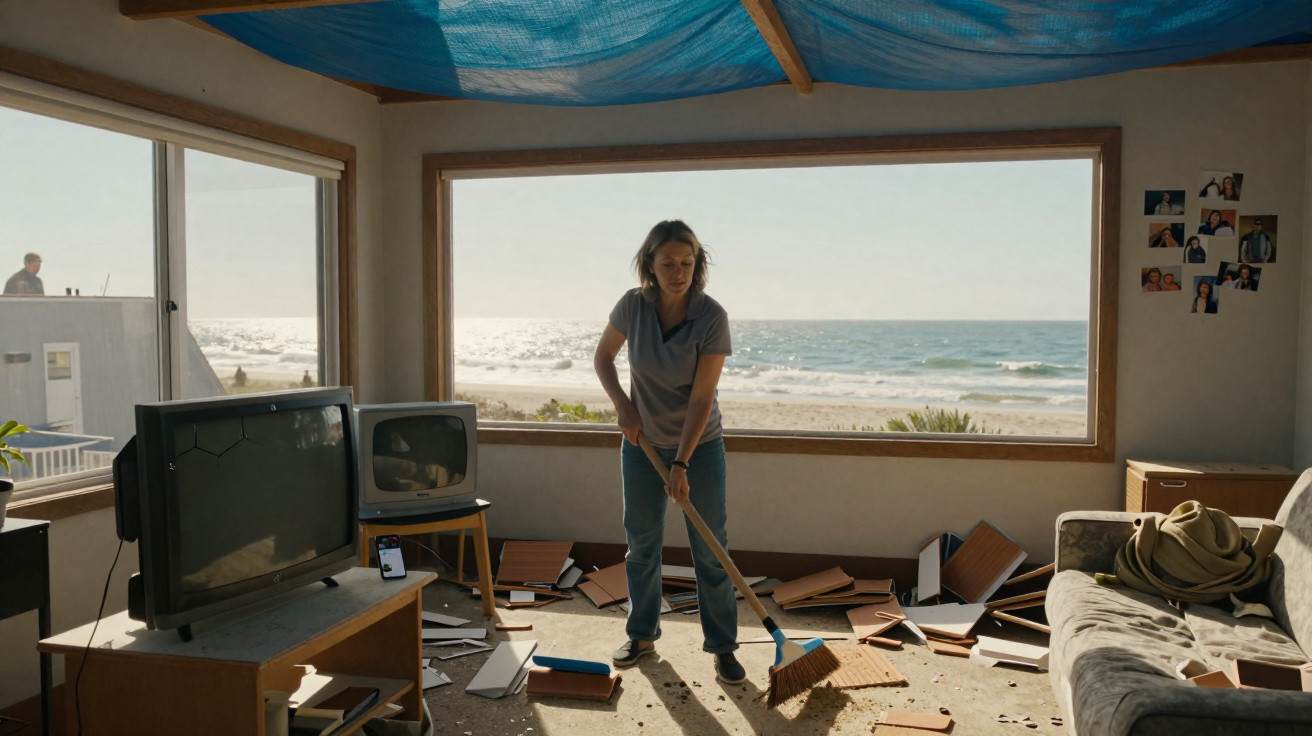
Four months have passed since the storm. Debris is still everywhere you look. The skyline is still lined with woodland left uncleared, roofs covered in tarpaulins, and electricity poles almost on the ground-still live-even beside places where children play. A great deal has been done, yet other signs are now surfacing: depression, anxiety disorders and panic attacks are beginning to multiply across the Leiria area, fuelled by the hardship left behind and visible every day.
It is a day of celebration in Vieira de Leiria. People work hard for the smiles and the upbeat atmosphere that a family-and-friends picnic, typical of Ear of Wheat Day, calls for. Even so, there is a sense of unease. On this bright late afternoon of 14 May, the wind has started blowing hard again, and nobody feels truly settled, despite the festive mood at the Praia da Vieira picnic park-happy chatter, loud conversation and music.
Nearly four months on from the early hours of 28 January-when Kristin tore off roofs and stripped away any feeling of safety in the Leiria district-the period since has been one of rebuilding, local support and mutual help. Yet whenever that night comes up, voices catch, sobs slip out, eyes fill with tears, a comforting hand lands on the back of whoever looks most fragile, and the same line is heard: "Right, it’s over now, we’re here celebrating." It is like a switch: sadness is abruptly shut off and, as far as possible, joy returns. But it never lasts long. Minutes later, someone else is pulled back into the same carousel of emotions. And so it goes-table by table, through the afternoon, and through the memories.
"Last week, the thunderstorms were so intense that we started ringing each other to check they still had electricity and water, and to all go to one house," Isabel Pedrosa recalls. "Now I’m just waiting for the worst-only the tsunami is missing," Antonieta Vitorino shoots back, fighting tears. Someone immediately raises their voice: "Come on, don’t think about that-have a few drinks. Look, we’re all OK."
At their table sit Susana Letra, Isabel Vitorino and Sandra Santos too, exchanging memories and criticism on the first major celebration since the storm. "Even with all the sadness, we tried to have the best party we could. The beach looks grey, everything is still to be done, and the bathing season will be here any minute," Isabel warns. "If it weren’t for friends, we wouldn’t have anyone," she continues. "The insurers don’t give us answers-some offer pennies, others nothing. The support the Government promised still hasn’t arrived; only the councils and parish councils stepped up, and they only didn’t do more because they couldn’t," they say. Many of the repairs visible along the beach have been paid for out of people’s own pockets. "Those who could did it; those who couldn’t, didn’t. A lot of people have had to get by using loans," they explain. "Despite everything that happened, we need these events and these chances to be together. Happiness is an essential good too," says Tiago Constantino, as a song plays in the background with a chorus repeating: "Thank God, everything will change, the day will come."
The deputy commander of the Vieira de Leiria Volunteer Fire Brigade is on duty with the crew, who have set up a tent at the Ear of Wheat Day festivities. "These events also help raise funds. The problems will be addressed according to financial capacity and by identifying the most urgent needs." The brigade’s damage tally already points to an extra 700,000 euros in losses and ten vehicles damaged. Stall takings will not be enough to undo the damage before the next bout of severe weather. Support is being requested.
Even amid the celebrations, Tiago can recite recent disasters that have hit Vieira de Leiria-and which he faced on the front line: "19 January 2013, a storm; 15 October 2017, the great Pinhal fire; in 2018, Leslie; in December 2019, Elsa; now this." Remembering Kristin still moves him. Beyond the destruction, the first two deaths caused by the 28 January storm were brought to the station on foot by people who could not call because communications were down-systems that are still being restored in many parts of the district. "We get used to being cold, and sometimes that can become a problem. We build up defences, but I feel the firefighters are motivated. We have to function and be present. We have to be our own saviours," he stresses, while assuring that everyone is ready for the challenges of summer.
"We have to be our own doctors"
Ana Jorge, 64, a shop counter assistant who lives in Fonte Santa in the Marinha Grande area, is full of energy as she tries-alongside her friend Elias and her daughter Arabela-to get rid of a huge pine tree still lying in the back garden. Behind them, the yard is in better shape, but the living-room windows remain shattered and held together with tape. "Fixing all this is back-breaking work and there’s nobody to do it. Neighbours help, but they’ve got their own things to sort out too," she says, using every spare hour to rebuild what the storm tore down.
Living right beside what is left of the Leiria pine forest, she is trying to make everything safe before the heat arrives-and with it the feared wildfires-but life no longer runs as it used to. Because the house is rented and the landlord is abroad and far removed from all this, Ana carries on as best she can, alone and at her own expense. "I tried to get support. A social worker told me yes, but then the council said no and the deadline ran out," she complains.
Yet the storm’s marks are not limited to what can be seen. "Sometimes I’m calm, watching my evening soap, and out of nowhere my heart starts racing at a thousand miles an hour. I have to run outside just to breathe deeply and see if I can calm down. For four months I’ve felt this three or four times a day," she says. She went to the health centre to ask for an appointment, but was told "there still aren’t any slots". "I was never like this, and I know this isn’t normal. You know, we have to be our own doctors," Ana Jorge sighs.
Ana Jorge’s symptoms are far from unique. "Week by week, I’m seeing more clinical cases of depression, increased reliance on sleeping medication, clearer anxiety disorders and panic attacks, across all age groups," says psychologist Susana Neves. She is part of Leiria Council’s psychological response project for teenagers and adults and the council has just hired two more psychologists to continue one-to-one appointments. "We’re preparing group programmes to work on these fear-related issues-fear is the word that has been voiced most so far by every age group. We hope to start the project as soon as possible." So far, around 400 requests for psychological support have been recorded on the helpline-244 243 867-and many home visits have also taken place.
Elsa Pereira, 51, from Maceira, has watched her pill box expand over recent months-and has seen the same happen with her 13-year-old son. Since late January, she has slept with him in the living room because the bedrooms-renovated three years ago for the two of them-are uninhabitable. "The floor has lifted, the walls are soaked with damp-you can feel it, you can smell it, and you can’t even stay in there," she explains. Kristin flooded her home and four months of leaving the windows open has not come close to drying out the damage, alongside ruined household appliances. She shuts doors simply to avoid looking.
On top of this have come insomnia and a depression diagnosis, now treated with medication. Her son is seeing the school psychologist and attending private psychiatry appointments after she was called into school because "the teachers thought it was strange the boy was always wearing short sleeves in the middle of winter and in the rain"-as if the bad weather that followed January were not already cold enough, or painful enough.
Leiria Council has launched its youth mental health project Reminder, "in partnership with child psychiatrists and family doctors", Susana Neves explains, offering free, ongoing online consultations for young people in the municipality aged 13 to 18. Requests had to be prioritised according to urgency. "We have around 15 young people in permanent follow-up."
Maria (a fictitious name), in her early 50s, is also dealing with Kristin’s impact embedded in her home and, above all, in her body. "I take medication to sleep and for depression, and at my age I’ve found myself already having to wear nappies at night," she admits through tears. The situation does not surprise the nurse and head of the Social Action Division at Marinha Grande Council. "That is a bodily response, but we have also found others, such as suicidal ideation [the act of thinking about, considering or planning one’s own death]," Ana Laura Baridó notes. In total, 84 requests for psychological support have been recorded across different age groups, with 31 receiving ongoing community-based responses.
Facing the destruction every day "is devastating", the nurse confirms. "A lot has been done, but the scale of the destruction is enormous. We were the lungs of the Central region and all of that is gone. The woodland, the trees-there’s nothing left there, and those were identity markers of this community, which creates a very strong emotional impact. The memories we had-everything is gone. It’s shocking," she adds.
Neighbours, social media and support that is slow to arrive
Elsa Pereira is still trying to rehabilitate her home, but as an unemployed mother raising a child, her money does not stretch far. The limited official support she has recently received-an annual payment of one hundred euros for her and the same again for the boy, to help cover psychiatric expenses-goes nowhere near meeting needs. With no insurance and no access to support because the house is tied up in an unresolved family situation, Elsa has been able to rely on neighbours, though she says not every offer comes with good intentions. "I have people helping me, but there were also conversations I really didn’t like and I refused: "I’m not for sale, I’m not for sale!"" she repeats, eyes brimming.
On Isabel Salvador’s street in Marinha Grande, the primary school still carries storm scars, with the chimney collapsed onto the roof. There is also a lighting pole bent in half, left leaning over vegetation and patched up as-is. On the bend in the road, ribbons hang as warnings around electrical cables, leaving people on edge. "There are children playing right next to this-it’s dangerous. They restored the power, but not the pole," warns Isabel, 55.
Part of the roof of this teaching assistant and influencer-who has around 300,000 followers-still has not been repaired. She already has contractors lined up and the insurance approved the money, but she waited almost four weeks. What helped was her community on social media, where she complained about the lack of answers. "I made the post and then even deleted it, but the truth is they came to inspect and they fixed it quickly," she says.
In a statement issued at the beginning of this week, the Portuguese Insurers’ Association (APS) says 72% of private claims have been concluded, including closed cases and situations involving advance payments. It adds that pending cases are linked to "external factors", such as delays in repairs, shortages of materials, or slow delivery of quotes and additional paperwork. Up to the start of this week, out of 205 000 claims reported by individuals and businesses, 145 000 "are already concluded or have advance payments". The APS also says 530 million euros has been paid out of an estimated total of 1300 million euros due to the succession of storms.
Tarpaulins on the roof and still no television
It is almost eight in the evening and Sérgio Silva, 52, is still up on one of his house roofs, adjusting tarpaulins. "They say it’s going to rain tomorrow and I have to be sure no water gets in here," he says. He and his wife, Sílvia, 54, live in Colmeias-further inland in the municipality of Leiria, but also badly hit-and they work on roofs and have been overwhelmed.
"Since the storm, we’ve properly repaired ten roofs and put tarpaulins on around 50, but we’ve still got loads of work," he says. There are just as many requests waiting and a phone that never stops ringing. "There’s so much to do, so many people asking, and not enough labour," they say.
Four months later, Sérgio and Sílvia still do not have television. Their son found them a temporary workaround. They wake each day to more work-and to a neighbouring business that was completely stripped of its roof by a wind that, "in ten seconds, took everything", even 20-tonne structures that crashed to the ground. Sérgio fears next winter will arrive with far too many homes still unrepaired. He praises the strength of the neighbourhood and the solidarity that spread across the country, bringing many people from far away to help in Leiria.
In conversations, criticism keeps surfacing about the promised funds that were meant to be de-bureaucratised to speed up processes. In Leiria, 10 739 applications were submitted to the Comissão de Coordenação e Desenvolvimento Regional do Centro (CCDR-C), with 1824 supports already granted and 931 cases in the payment phase. In the week of 11 to 17 May, the municipality reported analysing 398 cases, with an approval rate of 88,8%.
In Marinha Grande, the head of Social Action says more than 3200 requests for support were submitted to the CCDR-C. "The council has already assessed all applications, but payment is a bit slow." In terms of social action, Ana Laura Baridó specifies that in the critical days after the storm, "1200 households with various needs were referred, half with damage to homes and the rest with other types of need, with 595 cases under follow-up". At present, six families are housed in modular homes, eight people living alone have no community-based solutions, and the council is moving ahead "with the rehabilitation of 18 houses to accommodate households who are living with relatives or whose homes were destroyed", she notes.
Recovery, grief and finding the courage to face the sea again
At Fonte Santa Primary School in Marinha Grande, teaching assistant Isabel Salvador feels that children aged three to six are recovering. "At the beginning, they were more frightened when they heard certain sounds, but now I can see they’re managing better. They’re still scared, but less." Bruno, nine, who lives in Leiria, still fidgets on the sofa when he hears news about that night. In a trembling voice, eyes downcast, he asks his mum or dad: "Can you change channel? I can’t watch this. I really don’t like hearing things about that night."
Many have already set off along the path of recovery. Children’s drawings-from ages three to ten-about that night, produced as part of the Intermunicipal Plan for Promoting School Success, show scenes of destruction. But as Pedro Cordeiro, the project coordinator and deputy to Leiria’s education councillor Anabela Graça, notes, the results vary widely: "Most portray an experience that isn’t associated with either pain or psychological suffering; some of them use bright, cheerful colours." "That tells us their experience was buffered by the fact it happened at night and they didn’t observe clusters of stressors, and we’re left with the sense that the children were protected not only by conversations, but also from the impact the wind and destruction could have had-winds, noises, trees falling," he explains. The initiative "Hugs that care" involved 2308 children from 20 schools and 118 classes, aiming to get the youngest pupils talking and naming the emotions that came out of the storm night, while reinforcing the school, teachers and class group as a space of safety, sharing and mutual support. Psychologist Ricardo Cardoso turned the night of Kristin-related depression and fear into a free ebook, "The noisy wind", a book that helps educators address children’s fear in dangerous situations.
Now, the confrontation is with "the hardship that still remains". "When we leave the cities and go to the outskirts, when we see villages, homes without roofs and traces of destruction, it’s visually striking because it brings memories back," says therapist Susana Neves. "There is a phase of anger, resilience and hope, and I compare this whole process, looking along the timeline, to the phases of grief. First, the shock-the feeling that none of this is real; then the anger-the "why did this happen to me?"; and finally resignation, acceptance, meaning we have to do something-and a lot has already been done-to feed this hope," she argues.
Perhaps that is exactly what led Rosa Figueiredo, 60, and her mother-also Rosa, 84-to travel the three kilometres that separate them from Praia da Vieira for the first time in four months. "Only now did we have the courage to come here," says the daughter, who works at the Vieira de Leiria parish council. Between January and May, they restored the parts of the house that were wrecked and are preparing for a new family life. "The wind took almost everything from my mum-except her clothes. Now we’re getting everything ready for her to come and live with me," the daughter adds.
"People had told me there was a lot destroyed and there’s a lot to do. The beach bars have disappeared," Rosa concludes, staring out at the scene. And the talk is not only about building work. There is inner strength to reclaim when the wind blows again and sand lashes your face, as it did on that Ear of Wheat Day celebration, on 14 May. By seven in the evening on the municipal holiday, there was not a single person on the streets of Praia da Vieira-only the rattling of awnings and the breeze rising once more. The picnic in the park had ended too, before sunset.






Comments
No comments yet. Be the first to comment!
Leave a Comment