
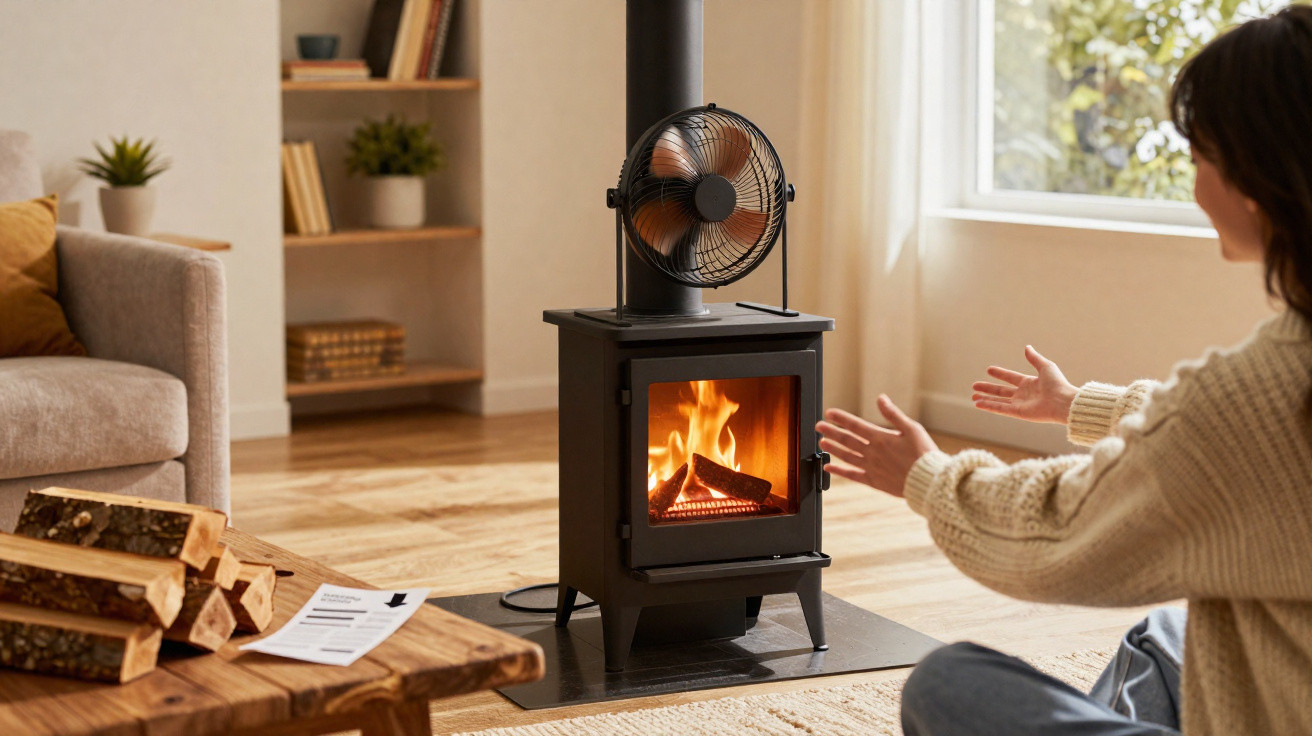
That pocket of hot air hovering around the stove can feel lovely, even as the settee on the far side of the room stays uncomfortably cool. A straightforward, heat-powered fan changes that dynamic by pushing warmth into the areas that miss out - often cutting firewood use too - all without adding a single watt to your energy costs.
What is a self-powered stove fan
A self-powered stove fan is a compact unit that sits on the hot top plate of a freestanding stove and uses the stove’s own heat to run. At its core is a thermoelectric module that generates a small electrical current when one side becomes hot while the other remains comparatively cool. That small current powers a low-draw motor, turning the blades to drive warm air sideways instead of letting it collect near the ceiling.
This relies on the Seebeck effect. The base pulls heat from the stovetop, while the finned heat sink above stays cooler by releasing heat into the surrounding air. Within the safe operating range, a larger temperature difference means a higher fan speed. There are no leads to connect, no batteries to replace, and no switches to remember.
No plug, no batteries: a temperature difference across a small module makes the fan spin and move warm air into the room.
Why rooms feel warmer with it
In a still room, the air naturally stratifies: the hottest air sits up high and lingers close to the stove, while cooler air remains nearer the floor. A gentle, continuous stream of air helps blend these layers, smoothing out hot and cold patches. The result is a more consistent room temperature, often achieved while running the stove at a lower burn rate.
- More even heat: helps ease the “roasting by the stove, chilly by the door” sensation.
- Faster warm-up: carries hot air further across the room in the first 10–20 minutes of a burn.
- Lower wood use: a steadier overall temperature can translate into fewer reloads.
- Quieter evenings: many models produce only a near-whisper hum because the motor is so small.
In real homes, owners often report using 5–15% less wood because the room reaches comfort at a lower stove setting.
A £25 gadget that runs on heat alone
In the UK, prices most often fall between £20–£70 (and $25–$80 in the US). It’s a one-off purchase, then it costs nothing to run whenever the stove is hot enough. There’s no wiring involved, and setup is essentially instant: set it on the rear or side area of the stovetop, make sure it has space for airflow, and let the fire power it.
How much can you save
What you save varies with how many hours you burn, how well your home is insulated, and how uneven the room temperature feels right now. Use the quick comparison below to get a rough sense of payback.
| Annual wood spend | Estimated reduction | Annual saving | Payback on £40/$50 fan |
|---|---|---|---|
| £200 / $250 | 5% | £10 / $12.50 | 3–4 seasons |
| £350 / $450 | 10% | £35 / $45 | About 1 season |
| £600 / $750 | 15% | £90 / $112.50 | Under 1 season |
If you rely on the stove most evenings from October to March, a mid-range fan commonly covers its cost within the first winter. Part of the value is comfort: when the edges of the room feel warmer, you can often run the stove a touch slower without feeling cold on the far side.
How to position and use it safely
Positioning makes a bigger difference than the number of blades. The goal is a hot base, a cooler top, and unobstructed airflow.
- Set the fan towards the back or side of the stovetop, rather than on a raised cook ring.
- Keep at least 10 cm of clearance behind it so the heat sink can shed heat effectively.
- Point the airflow into the room, not straight at a wall 60 cm away.
- Use a stovetop thermometer; most fans work best with 150–300°C (300–570°F) at the base.
- Steer clear of 350°C+ (660°F) at the base; sustained overheating can destroy the module.
- Only lift it by the handle, and only once it has cooled; exposed metal can burn skin.
Signs your stove is too hot
- The fan suddenly races, then slows or stops as a thermal cut-out activates.
- The heat sink discolours or you notice an odour similar to hot paint.
- A stovetop thermometer stays in the “overfire” zone for more than brief spikes.
Keep a stovetop thermometer in view; it protects both the fan and the stove from over-firing.
What to look for when buying
Specifications differ far more than product photos imply. It’s usually better to judge a self-powered stove fan by the points below than by the blade style alone.
- Temperature range: confirm the minimum start temperature as well as the safe maximum.
- Airflow: prioritise credible figures around 120–220 m³/h (70–130 CFM) for small rooms.
- Blade design: two or four blades can both perform well; larger blades often shift air at lower speeds.
- Overheat protection: a bimetal strip in the base can help lift the fan if it overheats.
- Materials: aluminium bodies and fins generally cope with heat better than thin steel.
- Noise: stronger models often remain under 25–30 dB at working temperature.
- Warranty: one to two years is a good sign the module and motor aren’t bottom-tier.
Limitations and when a fan won’t help
This isn’t a magic fix. In very large, broken-plan areas, heat can escape faster than a single fan can redistribute it. Shut doors stop warm air from travelling. Drafty windows and weak insulation can wipe out the benefit. If you have an insert stove recessed behind a decorative surround, you may be better served by a dedicated blower rather than a stovetop fan. And if you’re trying to move heat into other rooms, a small, quiet doorway fan positioned near the ceiling can help carry warm air down the hall.
Maintenance and lifespan
Every few weeks, remove dust from the blades and heat sink - dust acts as insulation on the fins and can push operating temperatures higher. When the unit is cool, wipe it with a dry cloth. Avoid adding oil unless the manufacturer explicitly provides a service point; many motors use sealed bearings. Over summer, store it away from the stove to reduce the risk of knocks and damp. With careful use, the thermoelectric module and motor commonly last several seasons.
Smart add-ons for better burns
- Moisture meter: target firewood under 20% moisture for cleaner burns and more heat per log.
- Rope gasket kit: improving the door seal helps control the burn and reduces runaway flames.
- Carbon monoxide alarm: fit one in the room with the stove and test weekly in peak season.
- Chimney thermometer or probe: useful for spotting cool, smoky burns that can build creosote.
Burn only seasoned wood under 20% moisture, sweep the flue annually, and install a CO alarm within hearing distance.
A quick, practical way to estimate your payoff
Find what you spent on logs last winter. Multiply that figure by 0.05 for a cautious estimate, 0.10 for a typical outcome, and 0.15 if your room has pronounced hot–cold zones. Then compare the result with the price of the fan you’re considering. If the saving covers half the purchase price or more, you’re often close to a one-season return. If you mostly burn at weekends, a smaller, cheaper fan can make more sense - comfort may matter more than strict payback.
A short checklist before you buy
- A freestanding stove with a flat metal top section large enough for a stable base.
- A clear airflow route across the room, with no shelf directly above the stove.
- A thermometer ordered, because keeping temperatures in check protects the fan.
- Sensible expectations: improved comfort, modest savings, and zero plugs.
When the temperature feels consistent from armchair to doorway, you naturally ease the fire down a notch and feel more at ease. That’s what a self-powered stove fan delivers: a small nudge that helps the heat you’ve already paid for reach the places where you actually spend time.





Comments
No comments yet. Be the first to comment!
Leave a Comment