
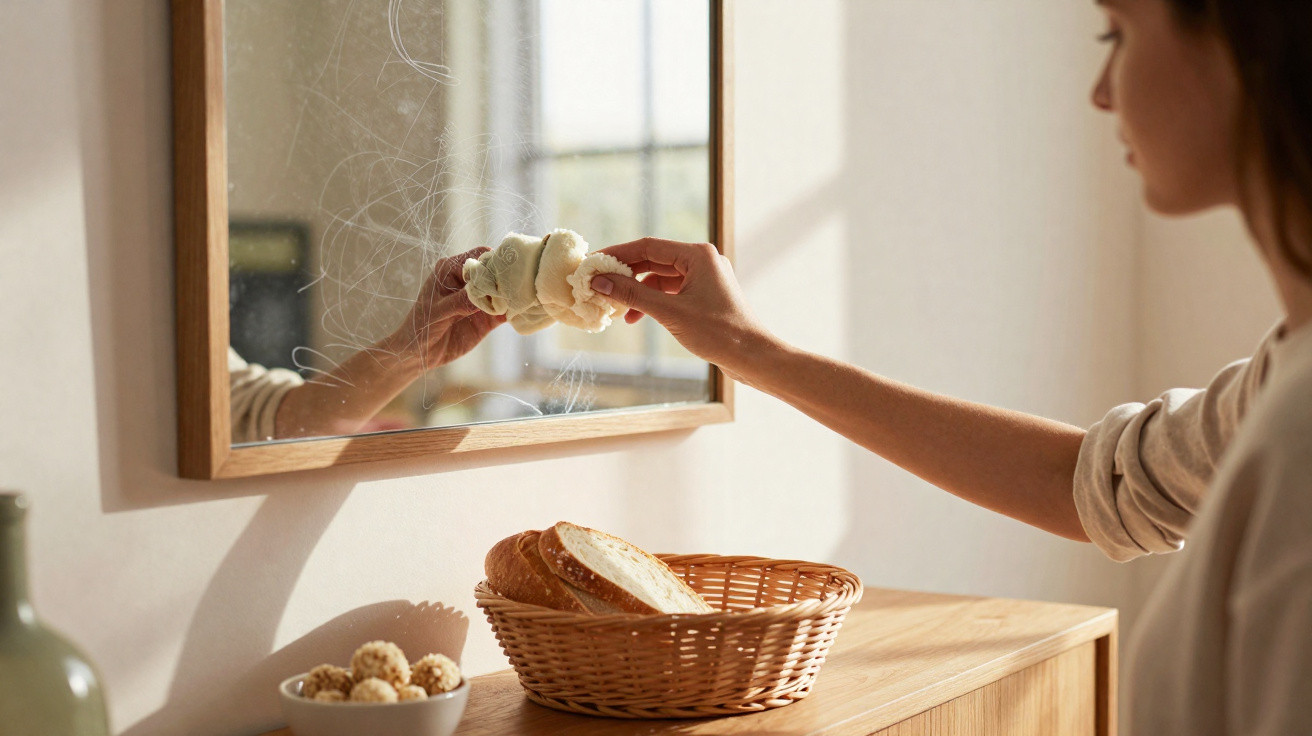
People who want to clean glass, antique paintings or delicate wallpaper often reach for pricey products from the chemist. Yet there’s an unassuming everyday food that can gently clean awkward surfaces, pick up micro-shards of glass and even make children’s scribbles fade - all without a heavy hit of chemicals. It’s a tip straight from grandma’s day, and it’s quietly returning.
An overlooked household remedy hiding in the bread basket
Some cleaning headaches are seen as “hopeless”: tiny slivers after a glass breaks, a fine layer of dust on an old oil painting, pencil marks on pale walls. In situations like these, standard cleaners can be too harsh - or they simply don’t work.
That’s where something nearly everyone has at home comes in: fresh, soft bread crumb from white toast or sandwich bread, with the crust removed. It doesn’t rely on chemicals at all; it works mechanically - gentle, springy and unexpectedly effective.
"Fresh, light-coloured bread crumb acts like a natural micro-sponge: it absorbs dirt instead of spreading it around."
That makes it a handy tool for anyone who wants to protect fragile surfaces, spend less, and avoid unnecessary chemicals.
Why bread crumb “traps” dirt better than many cleaning products
The porous structure grabs micro-glass
Bread crumb is made up of a network of tiny air pockets. These “gaps”, created as dough rises, form a soft, fine catch-net. When glass shatters, the most dangerous pieces are often the ones you can barely see - tiny, flat fragments left on the floor that slip right past a broom.
If you carefully press a piece of soft bread crumb onto the area, the fine glass particles push into the elastic interior and stick there. Unlike sweeping, they aren’t shoved across the floor or stirred up into the air as gritty dust.
The process is straightforward:
- Remove larger pieces of glass using gloves and a dustpan.
- Shape the bread crumb into a flat “pad”.
- Press it gently onto the affected area several times.
- Put the used bread crumb straight into the household bin.
This noticeably reduces the risk of tiny cuts to feet - especially in homes where children walk around barefoot.
Elasticity instead of abrasion: dirt is lifted, not smeared
A dry cloth often just pushes dirt from one place to another. A brush can scratch sensitive finishes. Soft bread crumb behaves differently: it compresses easily, moulds to the surface, and draws dust and particles into itself.
That’s why it can suit materials that are easily damaged, such as:
- older oil paintings
- vintage wallpaper with a delicate top layer
- matte wall paints that scuff and roughen easily
"Bread crumb works like a kitchen eraser: it loosens dirt without scratching or scrubbing."
Delicate surfaces that benefit from bread crumb
Dusting old oil paintings and picture frames gently
If you have an inherited picture or a second-hand find on the wall, the question soon arises: what can you use to clean it without softening the paint layer? Liquid cleaners, alcohol and aggressive sprays are off-limits because they can attack varnishes and binders.
For light soiling, soft bread crumb can lift dust and fine particles carefully. Here’s how to do it:
- Pinch off a small, fresh piece of bread crumb.
- Squeeze it briefly between your fingers until it forms a soft little ball.
- Dab the surface with light, vertical pressure - do not rub.
- Swap to clean crumb regularly.
Over time, colours can look clearer because the grey film of dust is removed. For highly valuable or heavily soiled artworks, a professional conservator remains the first port of call - but for everyday, light cleaning, bread crumb can work surprisingly well.
Pale walls: reducing pencil marks and children’s scribbles
Graphite from pencil clings stubbornly to painted walls. Standard erasers often leave grey smears or rough patches. Soft bread crumb can loosen these marks in a gentler way.
For pencil lines or faint coloured-pencil marks, this approach helps:
- Use only fresh crumb that doesn’t crumble.
- Test very carefully in an inconspicuous spot first.
- Press lightly onto the mark and lift away - no rubbing.
- Repeat several times until the line looks noticeably lighter.
This can tone down many children’s “masterpieces” without immediately having to repaint the entire wall.
Protecting glass and mirrors rather than scratching them
Thin glassware, old mirrors or glass doors can react badly to crumbs, dusty grit or rough cloths. When you wipe quickly, those particles can be dragged across the surface without you noticing - leaving fine scratches behind.
If you start by using bread crumb, you can remove loose particles gently first. Only then should you do the usual cleaning with glass cleaner or a lightly damp microfibre cloth. This lowers the chance of new scratches, and older mirrors in particular keep their clear shine for longer.
Why white bread without crust works so well
The right type makes all the difference
Not every slice of bread is suitable as a cleaning aid. Soft, white toast or sandwich bread without the crust works best. The crust can be hard, may leave scratches, or can break down into gritty crumbs that then cling to the item you’re trying to clean.
| Bread type | Suitability for delicate surfaces |
|---|---|
| White toast bread without crust | Very good – soft, elastic, hardly any crumbs |
| Fresh mixed or white loaf with crust | Limited – remove the crust first |
| Wholemeal bread | Not very suitable – coarse texture; grains can scratch |
| Old, dry bread | Unsuitable – crumbles heavily; hardly elastic |
Ideally, use bread that no longer feels perfect to eat, but is still soft enough to remain springy. That way it doesn’t end up in the bin - it gets a second life as a cleaning helper.
The correct technique: dab, don’t rub
Success depends heavily on how you move your hand. If you rub out of habit, you either spread the dirt or apply too much pressure. The aim is to draw particles into the bread crumb, not smear them around.
"The most important point: always dab vertically; never push back and forth with pressure."
Practical handling tips:
- Use pieces small enough to hold comfortably between thumb and forefinger.
- After a few dabs, switch once the bread looks visibly dirty.
- Don’t use it on damp or greasy areas - the bread is more likely to stick.
- Afterward, lift any loose crumbs with a soft brush or a dry cloth.
Learned from grandma: an old tip with modern logic
Before cleaning aisles were packed with products, housework relied far more on simple basics. Bread crumb served as a stand-in for an eraser, a dust-catcher on pictures, and a helper after broken glass. With the rise of chemical cleaners, this little trick largely disappeared.
Today, anyone who wants to shop more consciously, keep fewer plastic bottles in the cleaning cupboard, and reduce allergens in indoor air may find this old household know-how a practical addition. Bread crumb is biodegradable, non-toxic and doesn’t need to be manufactured for the purpose - it’s already there.
Of course, it won’t replace every cleaner. Grease stains in the kitchen, limescale in the shower, or stubborn mould require different tactics. But for very sensitive surfaces, light dirt, and awkward situations like micro-glass after an accident, this simple food can be remarkably useful.
If you’re unsure, always try it first in an inconspicuous area. That lets you check whether paint, finish or material reacts. In many cases, you’ll find that a quick look in the bread basket is enough to leave some of the cleaning chemicals in the cupboard - without sacrificing cleanliness or safety.

Comments
No comments yet. Be the first to comment!
Leave a Comment