
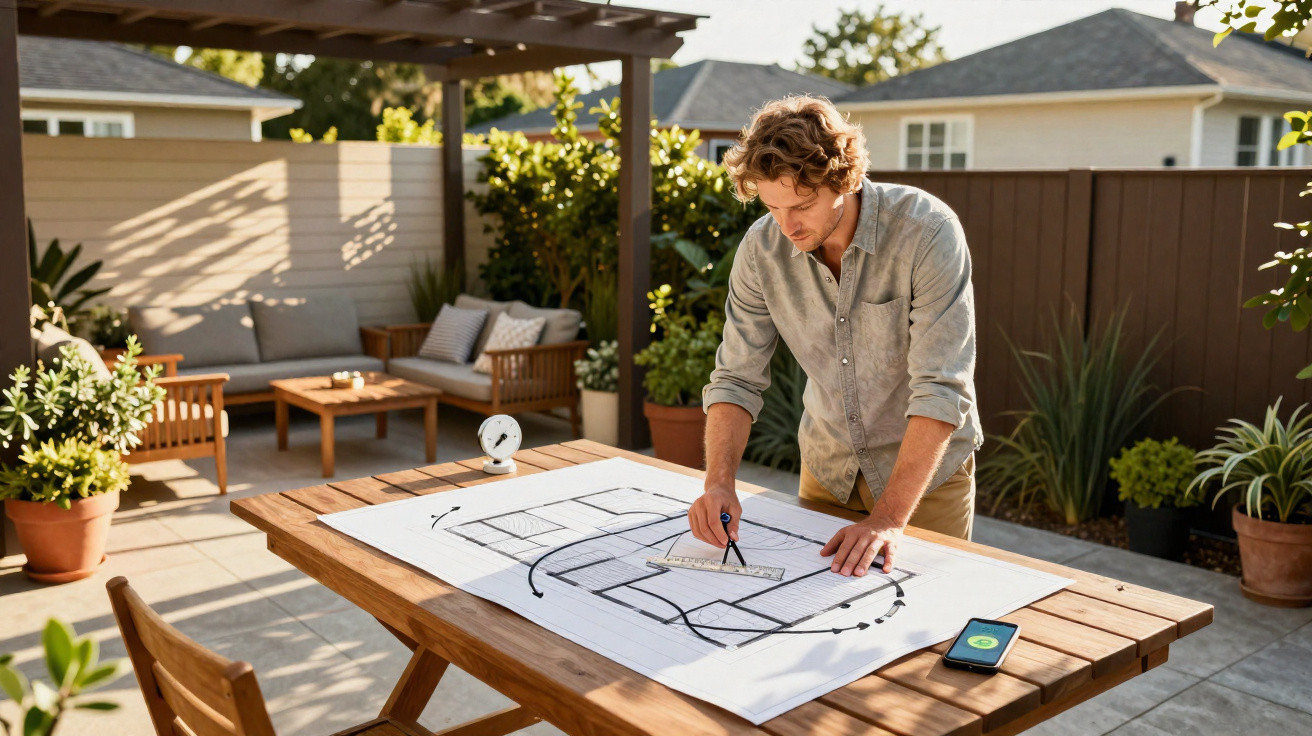
By about 5.30 pm, the heat out on the patio can feel almost confrontational. The plastic chair scorches the backs of your legs, the salad slumps in its bowl, and the dog has disappeared into the only thin strip of shade-tucked behind the bins. You pictured long apéritifs here: honeyed evening light, chatter, and a faint breeze. Instead, you’re squinting, sweating, and shuffling the chair around like a sundial to keep out of the sun.
Then, two hours later, that very same patio turns bitterly cold. Wind barrels down the alley, your drink gets knocked over, and the neighbour’s window suddenly offers a perfect view of your dinner plate. You can’t quite work out what’s going on.
The tiles look great, the furniture is new, and you’ve added plants and lanterns.
Still, something doesn’t feel right.
Your patio isn’t “bad” - it’s badly oriented
Most of us assess a patio by what’s on it: the table, the cushions, the fairy lights. But what really determines whether you’ll use the space is harder to spot-how sunlight, shade and wind travel through it across the day. A south-facing terrace isn’t automatically heaven, and a north-facing corner isn’t automatically a sentence. What matters is how those forces land on the exact place you actually sit.
A patio that photographs beautifully at 11 am in a property listing can become a blistering oven by 4 pm in July.
And that’s the point you realise the patio is the one in control.
Picture a typical city balcony, west-facing, three storeys up. In March, it’s idyllic: gentle after-work light, the first glass of wine of the year, a jumper draped over your shoulders. You think, “I’ll spend the whole summer out here.”
Then July arrives. From 3 pm to 7 pm, the sun slams into the railing, the metal gets hot, the wall throws the heat back, and the air turns thick and unmoving. The balcony that felt snug in spring becomes close to unusable on the hottest days.
Nothing about the decor changed-only the sun’s angle and the way the shadows stretch.
There’s a straightforward explanation: your patio isn’t a still photograph. It’s a small stage where the cast (sun, shade, wind) shifts hour by hour, season by season. In summer the sun sits higher; in winter it stays lower, sliding east to west and changing how it strikes your façades. A low winter sun can sneak beneath awnings and warm you, while a high summer sun hits the top of the wall but doesn’t push far into the space.
And wind doesn’t simply “blow”. It funnels between buildings, curls around corners, and rebounds off fences. A slight change in orientation can either shelter you-or turn your table into a sail.
Once you start reading your patio as a moving map, the comfort problems stop being mysterious.
How to read your patio like a weather engineer (without a PhD)
The most useful approach begins with something almost embarrassingly simple: watch your patio for a full day. Pick a Saturday. From your first coffee through to late evening, step outside each hour and take a quick photo from the same spot. Jot down the time, where the sun lands, where the shadows sit, and whether the air feels calm or exposed. Don’t analyse-just capture what’s happening.
When the day’s done, scroll through the photos like a time-lapse. You’ll notice the sun “walking” across the floor, the wall warming up and later releasing its heat, and the precise moment your table finally drops into shade.
All of a sudden, your patio has a pattern.
After that, bring in a compass. Your phone has one, usually hiding next to the torch and the calculator you hardly touch. Stand with your back against the house wall and check the direction you’re facing. That’s the way your patio opens to the sky. South usually means long spells of light (and potential overheating). East tends to give bright mornings and cooler evenings. West brings sunsets-and those punishing late-afternoon rays. North offers gentle, consistent light, and sometimes a maddening chill in spring.
Most people know that sinking feeling when they realise the sun never reaches the spot they imagined for the deck chair.
That isn’t misfortune. It’s geometry.
Now add wind to the picture. Ignore the weather app for a moment. Tie a light scarf or thin ribbon to the railing or a plant cane and leave it there for a few days. Each time you pass, note which way it flutters-and when it suddenly snaps harder. Very quickly, you’ll spot two or three regular wind “routes” and the times they tend to appear: afternoon gusts from the west, evening breezes coming off the river, or cold draughts slipping through the gap between two buildings.
Be honest: hardly anyone keeps track like this every day.
But one deliberate week of noticing can tell you more than any catalogue photo or Pinterest board ever will.
Turning harsh sun and stray wind into comfort and privacy
Once you’ve mapped how light and wind move, small, precise tweaks can change everything. If late afternoon turns your patio into a hotplate, shift the main seating area 50–80 cm closer to the wall so it catches the building’s shade earlier. Put a vertical element exactly where the glare hits your eyes: a tall plant, a trellis, or an adjustable shade sail mounted slightly higher on the sunniest side.
If you’re dealing with a cooler, north-facing patio, flip the strategy. Bring the table out of the wall’s constant shadow, and place a pale surface (a light rug, a white or light-wood table) where it gets the most daylight so it bounces brightness back towards where you sit.
You’re not battling the sun or the wind-you’re making terms with them.
A common mistake is buying shade and privacy “by the metre” without considering direction at all. People install one large fixed awning, then discover it steals winter light and still allows low evening sun to knife in from the side. Or they build a solid windbreak on the wrong edge, only to create a wind tunnel straight along the table.
It’s often smarter to use a few smaller, flexible pieces: a parasol that tilts and can be left half-closed, a bamboo screen you can slide, a tall planter on castors. That way you can respond to July heat, April coolness, and that oddly blustery week in September.
It’s not about a “perfect” layout-it’s about having choices.
Sometimes the most luxurious patio is simply the one where you don’t have to think about the weather every ten minutes.
Use your new light-and-wind map to set up three essential zones.
- Comfort zone: where your main chairs or sofa go, a little shielded from the strongest sun and gusts, but not sealed off from fresh air.
- Privacy zone: a corner softened with tall plants or a screen, positioned to match the neighbour’s sightline or the view from the street.
- Durability zone: the spot for furniture and materials that will weather well under the exposure you measured, not the exposure you wish you had.
When these zones line up with the real sun and wind patterns, you dramatically increase the chance you’ll use the patio on ordinary Tuesdays-not only on picture-perfect days.
A patio that ages well is one you actually live in
Once you begin paying attention to how your patio “breathes”, you’ll start noticing details you previously missed. The corner where cushions never properly dry after a shower. The precise time the neighbour’s shadow finally lifts off your tiles. The way the wind always makes one decorative lantern rattle while the low plants barely move.
From there, decisions become simpler. You choose textiles that can cope with your particular sun. You fix the parasol where it genuinely needs to hold, not where the base looked nicest. You accept that one corner will always be a bit untamed-and you use it as a buffer instead of constantly fighting it.
You may also realise that what felt like a “problem” orientation comes with its own advantage. A north-facing patio that stays cool when the rest of the city is sweltering. A small east-facing balcony that gives you soft morning light for yoga and leaves your evenings free for a walk. A breezy corner that becomes the only place you can still breathe on a humid day.
The real luxury isn’t having the “best” orientation.
The real luxury is understanding yours so well you can adjust it, refine it, and live with it-season after season-without constantly being at war with the weather.
| Key point | Detail | Value for the reader |
|---|---|---|
| Observe before changing | One full day of photos + a week with a ribbon to read sun and wind | Prevents expensive mistakes and decor choices that don’t match real conditions |
| Think in zones | Comfort, privacy and durability areas aligned with light and wind paths | Makes the patio practical day-to-day, not only on “perfect” days |
| Use adjustable elements | Tilting parasols, mobile planters, sliding screens, light fabrics | Adapts to seasons and microclimate without constant remodelling |
FAQ:
- How can I quickly work out my patio’s orientation? Open your phone’s compass app, stand with your back to the house wall, and read the direction you’re facing. That’s the direction your patio opens to the sky.
- Is a north-facing patio useless? No. It’s usually cooler, more consistent, and kinder on materials. You’ll simply rely more on lighter colours, reflective surfaces, and moving seating towards the brightest edge.
- What’s the best orientation for a hot climate? East or north-east often suits: mild morning sun, then shade during the hottest hours. With south or west, you’ll generally need more shade sails, plants and light-coloured materials.
- How do I cut wind without enclosing the whole space? Use partial windbreaks: offset screens, tall grasses in planters, or perforated panels that slow the airflow rather than stopping it dead.
- My patio is already built. Is it too late to improve it? No. You can still change where you sit, how you create shade, and which materials you rely on. Sometimes shifting the table by one metre and adding a single vertical screen changes everything.
Comments
No comments yet. Be the first to comment!
Leave a Comment