
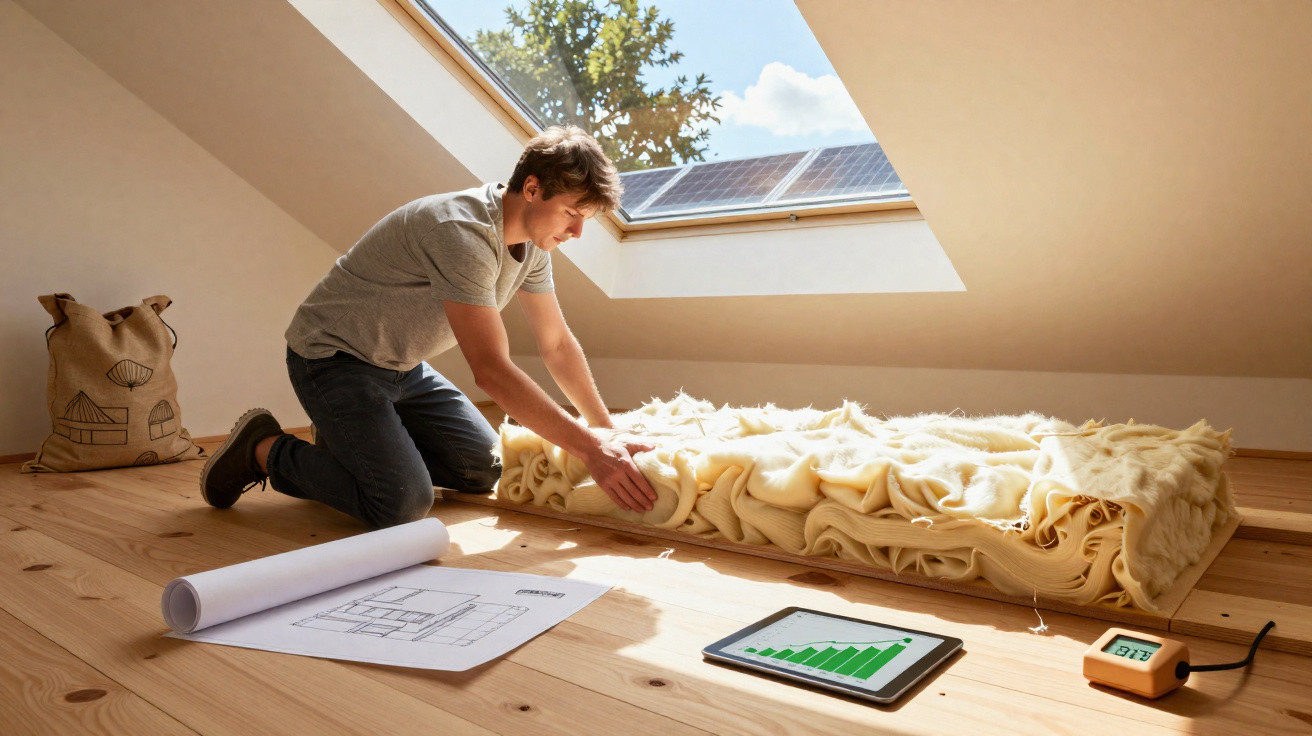
Many homes effectively burn money because of poor insulation - but a natural material is now aiming to improve energy use, living comfort and property value at the same time.
As conventional insulation products come under pressure over climate impacts and recycling concerns, an old raw material is being given a new job: flax. The fibre from an unassuming plant is quickly becoming a standout in modern ecological building projects - and over the coming years it could also become a genuine value driver for residential property.
Why good insulation is worth real money today
Insulation has long been about more than warm feet in winter. It directly affects energy consumption, running costs, CO₂ emissions - and therefore the market value of a house.
- Lower heating bills in winter
- Reduced reliance on air conditioning in summer
- Improved sound insulation against traffic and neighbour noise
- Lower CO₂ emissions and a better overall energy balance
Energy losses are particularly severe in older buildings: heat escapes through the roof, external walls, window reveals and basement ceilings. Traditional options such as mineral wool or polystyrene can help, but they also raise fresh questions - from energy-hungry manufacturing processes to difficult end-of-life disposal.
Anyone renovating today is no longer looking only at insulation performance, but also at a material’s origin, health impact and recyclability.
Flax as an insulation material: an old crop with a new purpose
Flax has been cultivated in Europe for centuries, mainly to produce linen. Now the construction sector is rediscovering the fibre - as an insulation material with an impressive set of characteristics.
Renewable, local and resource-efficient
Flax thrives in temperate regions such as northern France, Belgium and the Netherlands - and it is increasingly being grown in Germany and Austria as well. Cultivation is considered relatively low-input:
- low water demand
- little to no additional pesticides required
- short transport distances when produced in Europe
The fibres are processed into insulation batts, boards or loose fill. Making flax insulation generally requires far less energy than producing many synthetic insulation products. This improves a building’s so-called embodied energy - a metric that is being weighted more heavily under newer energy and building standards.
Technical performance you notice in day-to-day life
Flax insulation is not only strong on environmental credentials; it performs convincingly in real buildings. Its thermal conductivity sits in a range that competes well with established materials. Where it becomes particularly interesting is how it handles temperature, moisture and sound together.
Flax insulates against heat, absorbs noise and can buffer moisture without losing its structure.
In winter, it helps keep warmth inside; in summer, it slows the entry of heat. This can be especially beneficial in lofts, because flax’s mass shifts temperature peaks later in the day. Rooms warm up more slowly and stay comfortable for longer into the evening.
There is also an acoustic advantage: the fibrous structure absorbs sound noticeably better than many rigid board materials. Anyone living on a busy road or in a tightly built-up residential area is likely to notice the difference quickly.
Healthier living without a chemical cocktail
Another aspect that matters to many people building or renovating is indoor air quality. Some conventional insulation materials can release fibres during installation or off-gas due to additives. Flax is among the comparatively “gentle” alternatives.
- no irritating glass or stone fibres
- no emissions of typical volatile organic compounds (VOCs)
- more pleasant handling for tradespeople and DIYers
Combined with clay plasters, timber structures or vapour-permeable external walls, it can form a wall build-up that helps regulate moisture. This reduces the risk of mould and supports a more stable indoor climate - particularly relevant for allergy sufferers and families with young children.
Where flax insulation can be used
Flax is surprisingly versatile and fits into many standard construction methods.
Renovation and new build
The fibre is available as:
- insulation batts for timber-frame walls, cavities and pitched roof slopes
- boards for internal and external walls, and service voids
- loose fill for voids, intermediate floors and hard-to-reach areas
Typical applications include:
- Roof: between rafters or on the top floor ceiling
- Façade: in ventilated cladding systems or timber-frame wall assemblies
- Internal walls: to improve sound insulation between living areas
- Floors: in timber joist floors or beneath dry screed
Because it is relatively lightweight, it can also suit existing buildings where the structure has limited reserve capacity. Many DIYers report that flax batts are significantly nicer to work with than mineral wool - no itching and no burning sensation on the skin.
How does flax compare with the competition?
In most builders’ merchants, polystyrene, mineral wool and stone wool still dominate. All three deliver solid insulation performance, but their environmental footprint and disposal routes are often debated.
| Material | Thermal insulation | Environmental profile | Recycling |
|---|---|---|---|
| Polystyrene | good | energy-intensive production, made from oil | difficult, often incinerated |
| Mineral wool | good | high energy demand in manufacturing | limited recyclability |
| Flax | good | renewable, can be produced regionally | recyclable, largely biodegradable |
Flax’s key advantage lies in its place within a circular material cycle: the fibre is fully reusable and can later be incorporated into other products or used again as insulation. In the best case, this creates an almost closed loop with no hazardous waste.
At present, the price is still somewhat higher than conventional insulation materials. However, as demand increases, technology develops and policy requirements for climate-friendly buildings tighten, costs are likely to converge. Government support schemes for energy-efficient refurbishments and low-CO₂ building materials can also offset part of the additional cost.
How flax insulation can influence property value
Energy efficiency ratings are becoming increasingly important in property valuations. A house with good insulation, lower heating costs and a transparent environmental profile typically sells faster - and for better prices.
Anyone refurbishing with sustainable insulation materials today not only improves comfort, but also positions their property for the future market.
Buyers in younger generations, in particular, pay closer attention to environmental criteria. They ask about the EPC, CO₂ balance and the materials used. Being able to document the use of natural insulation such as flax can therefore become a negotiating point that ultimately pays off.
Who benefits from switching to flax?
Flax insulation is especially well suited to:
- timber construction projects and lightweight extensions
- energy retrofits with a strong focus on healthy living
- architect-designed homes and plus-energy house concepts
- people who value regional value creation
Even for a straightforward roof refurbishment on a detached house, changing the insulation can make sense. If you are already paying for scaffolding, labour and new roof coverings, the insulation choice is only a comparatively small part of the overall spend - with long-term effects on energy bills and living quality.
What clients should check before deciding
Despite its many strengths, it is essential to look closely at the complete build-up. Not every construction type suits every insulation material. Designers and energy advisers should, among other things, assess:
- What does the full wall or roof build-up look like?
- Is the assembly genuinely vapour-permeable so moisture can escape?
- Which fire safety requirements apply to the specific project?
- Which support schemes incentivise ecological materials?
As a rule, flax is treated with natural or approved fire-retardant agents to meet legal requirements. It is worth checking the technical data sheets here too, especially if the goal is a fit-out with as few pollutants as possible.
Practical examples and combination options
In real projects, several combinations have proved particularly attractive:
- Flax between timber studs, clay plaster inside, timber cladding outside - popular in ecological new builds.
- Loft conversion with flax batts between rafters, complemented by wood fibre boards externally for summer heat protection.
- Sound insulation in apartment blocks: flax in partition walls and floor voids to reduce impact noise.
If you are renovating a typical older property, an energy adviser can calculate how different insulation options affect heating costs, the CO₂ balance and potential grant levels. In many scenarios, flax does not come out as the lowest-cost material line, but in the overall picture it can perform surprisingly well - thanks to a better feel at home and a future-ready material choice.
Ultimately, flax insulation is more than just another item on a specification list. It reflects a wider shift emerging across Europe: away from purely low-cost solutions and towards buildings that save energy, conserve resources and support healthier living. If you are renovating or building now, it is an option that can make everyday life more comfortable while also helping to underpin the long-term value of the property.




Comments
No comments yet. Be the first to comment!
Leave a Comment