
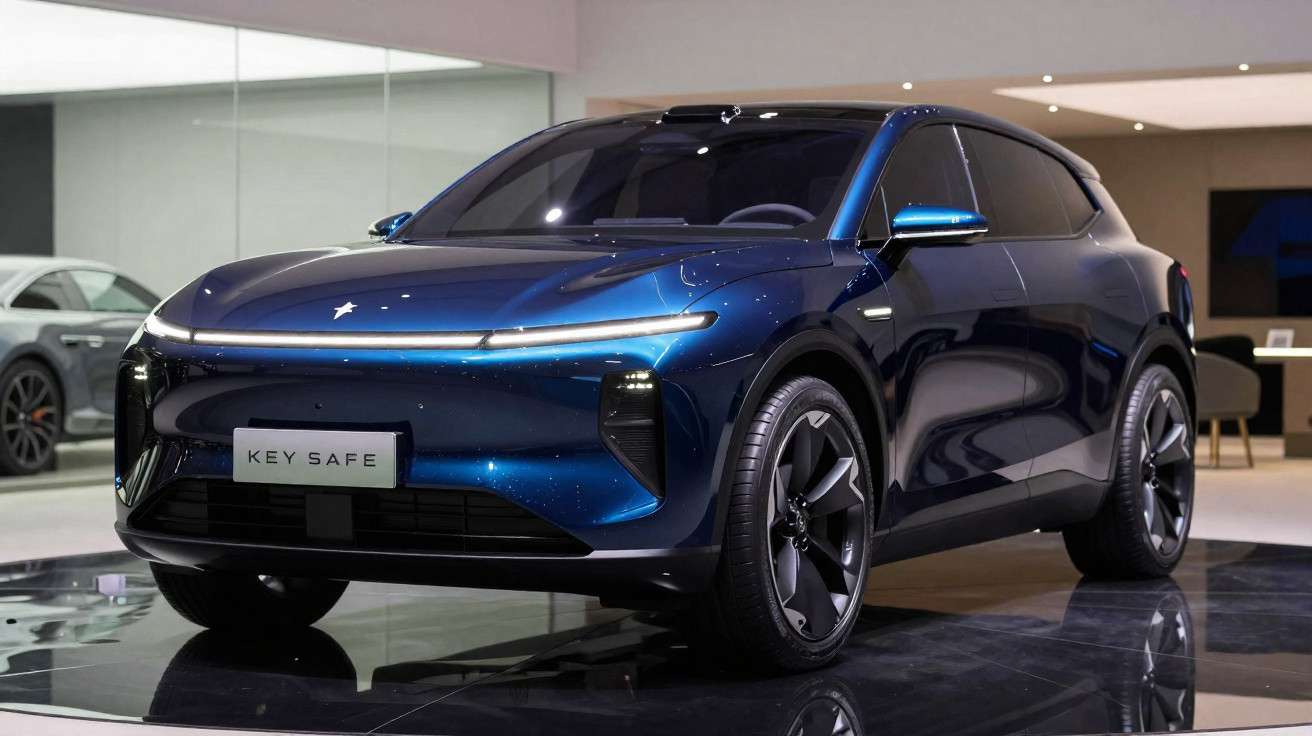
Hoodie up, trainers on, phone in hand. He isn’t picking a lock or smashing a window. He’s simply holding a small, dark gadget, loosely aimed at the house. About 30 seconds later, your car’s lights blink once on the drive. The doors click open. The alarm doesn’t make a sound.
You’re in the kitchen, washing up, with no idea that the signal from your car key has been captured through the wall and boosted straight back to the vehicle. No broken glass. No engine being revved. Just a near-silent theft that takes less time than reheating last night’s dinner in the microwave.
When you realise the car has vanished the next morning, all that remains is an empty stretch of kerb and the same unsettling thought: how was it that easy?
The explanation may be closer than you think - right by your front door.
Why criminals love your “smart” keys more than you do
Take a walk along an ordinary residential road late at night and you’ll notice a familiar picture: cars parked neatly, keyless entry systems effectively on standby, waiting for a signal. Those “smart” keys you rarely even take out of your pocket don’t truly go quiet - they keep talking to your car even when you aren’t touching them.
For you, that’s the whole selling point: convenience.
For a particular kind of thief, it’s a round-the-clock opportunity.
Keyless entry fobs send out a low-power radio signal. Get close enough and the car detects the fob and unlocks. The weakness is that “close enough” isn’t fixed. With inexpensive amplifying kit bought online, criminals can pick up that faint signal from inside your hallway and extend it out to the car on your driveway.
It sounds like something from a film, yet it’s playing out on perfectly normal streets.
Across Europe, the UK and the US, police reports now regularly include terms such as “relay attack” and “signal amplification theft”. In some areas, insurers privately acknowledge that a sizeable share of modern car thefts happen without a single window being smashed.
Typically, it works like this: one person approaches your front door or an external wall, holding a signal booster roughly the size of a paperback. A second person waits by your car with another device. The first unit searches for the faint radio transmission from the key fob inside the house - often left on a console table or dropped into a bowl.
As soon as it finds the signal, it strengthens it and relays it to the second thief. To the car, it’s as if the key is right beside it. The doors open. The engine starts. No PINs guessed. No security codes cracked. No alarm triggered. Just a “ghost key” created out of thin air.
In 2023, several European insurers reported that certain keyless SUVs and premium models were being taken in under 90 seconds using this exact method. Some makes became such frequent targets that owners saw their premiums rise largely because of the key system.
Speak to people who’ve had it happen and the details often match. No disturbance overnight. No footage of anyone forcing entry. Just a hooded figure lingering briefly near the front door - and then a car quietly rolling away.
What was marketed as “effortless convenience” has, in practice, opened a silent shortcut for organised gangs.
So what does kitchen foil have to do with any of this?
How a simple sheet of aluminium foil can shut the door on relay attacks
Think of the radio signal from your key fob like a tiny, invisible beam. Aluminium foil acts like a shutter. Wrap the key and you create a basic Faraday cage, blocking, reflecting or weakening the signal until the relay devices have nothing useful to amplify.
There’s no mystery to it - just straightforward physics, used in a deliberately low-tech way.
At home, the process is almost absurdly easy. Tear off a generous piece of kitchen foil, wrap the car key fob so it’s completely covered, then put the small silver bundle somewhere away from doors and windows. Done. No subscription, no app, no updates.
Is foil flawless? Not quite. If the foil is thin, ripped or poorly folded, a little signal can still escape. Even so, for many keyless systems a basic wrap makes the theft far more difficult. Often, that extra hassle is enough for thieves to give up and try the easier option a couple of houses along.
There’s a second advantage too: wrapping your key makes you stop leaving it in that convenient bowl by the front door. That bowl, in reality, is almost like a beacon for relay thieves passing on the pavement.
On a human level, this isn’t about living on edge. It’s about introducing one small piece of friction into a crime that has become far too smooth.
When people first hear “wrap your keys in foil”, they often chuckle or feel slightly daft. It can sound like something a paranoid relative would post in a Facebook group at 2 a.m.
But if you speak to cyber-security professionals and investigators who focus on vehicle crime, a pattern emerges: many use some kind of signal-blocking at home, particularly with keyless cars. Some prefer purpose-made Faraday pouches. Others rely on metal tins. And plenty admit they’ve used aluminium foil at least once - even if only to test whether their key was continuously chirping to the car.
A driver in London stumbled on the issue by chance. He noticed his car would sometimes unlock when he walked past his own front door from inside the house. The key was hanging on a hook less than a metre from the wall. Once he wrapped it in foil, the “ghost” unlocks stopped overnight.
After that, it’s hard not to notice. Ordinary routines begin to look like invitations.
The principle is straightforward: criminals can’t amplify a signal that isn’t leaving the house. By blocking or weakening the radio waves at their source, you aren’t trying to beat elite hackers - you’re simply closing a gap that was effectively left open by design.
There’s a mindset change here as well. When you start thinking of your key as a device that broadcasts - rather than a harmless object - you naturally reconsider where you put it, how you store it, and what that means overnight. It’s a gentle push away from blind faith in “smart” convenience and towards a more alert relationship with your own belongings.
Turning foil into a simple, daily security habit
So how do you make this workable without making your home feel like a DIY bunker? Begin with one key. Tear a rectangle of aluminium foil large enough to wrap the fob at least twice. Put the key in the centre, fold the sides over, then fold again so there are no clear gaps and no corners sticking out.
Once it’s wrapped, test it: walk up to the car with the foil still on. If the doors don’t unlock automatically, that suggests the signal is being blocked or heavily reduced. If the doors still open without effort, add another layer or try a slightly thicker foil.
At home, pick a consistent place for your wrapped key. A drawer. A metal biscuit tin. A small box on a shelf away from the front door. The aim is to make it a small routine: keys in, lid shut, day finished. It takes less time than scrolling your notifications one last time before bed.
There are, of course, very normal ways this falls apart. You might forget to wrap the key again after driving. You might leave it on the table “just for tonight” - and then slide back into the old habit for months. Or a partner might quietly decide you’ve gone a bit far with the silver parcels.
That’s where a little empathy matters. Most people are tired in the evening. Nobody wants yet another task added to an already hectic routine. So don’t chase perfection - aim for “most nights, without worrying about it”.
Let’s be honest: hardly anyone manages this every single day.
If foil feels too odd, treat it as a short-term experiment and then buy a small Faraday pouch or a metal key box once you’re persuaded the risk is real. The main benefit isn’t the foil itself - it’s cutting the invisible connection between your sofa and your car door.
“I used to laugh at the idea of wrapping my keys,” says Mark, a 38‑year‑old engineer who had his SUV stolen from right outside his home. “The police officer showed me CCTV of the guy standing by my front door with some kind of antenna in his hand. I went out the next day, bought foil and a metal tin, and I’ve never left my keys by the door since.”
Treat foil as a basic, entry-level shield rather than a permanent way of life. For many people, it also triggers better habits that offer stronger protection:
- Move where you store your keys so it’s away from doors and windows.
- Use foil or a Faraday pouch overnight, particularly if the car is on the driveway.
- Ask your dealer whether your car has a “sleep” mode for the keyless system.
- Consider a visible steering wheel lock as an extra deterrent.
- Speak to neighbours about relay theft so the whole street becomes less appealing to criminals.
At a deeper level, that small silver wrap is also a statement: choosing not to let convenience automatically outweigh security.
A small piece of foil, a bigger conversation about “smart” life
There’s something almost poetic about countering high-tech car theft with the same material you use to cover leftover pizza. It highlights the gap between the polished promise of “keyless” living and the blunt way the technology behaves in the real world.
We now live among objects that communicate constantly: keys, locks, cameras, thermostats - even fridges. They exchange signals while we sleep. Most of the time, nothing goes wrong. Then one morning a car is missing from the kerb, and a household has to rethink its commute, its finances and its sense of safety.
Psychologically, relay theft can feel particularly violating because nothing looks damaged. You wake up to an intact home: windows untouched, front door still locked. The intrusion is invisible. That’s why a visible, physical action like wrapping your keys in foil can feel so grounding. It gives you something practical to do, not just something to worry about.
Most of us know the feeling: you check the door, then check it again, then lie in bed replaying the sound of the lock. Wrapping a key doesn’t make you a paranoid survivalist. It simply adds an extra layer between your private space and people who view your car as a resellable item on a list.
Some readers will try this tonight and feel slightly less exposed. Others will write it off as unnecessary. Both reactions are genuine. The quieter reality is that car thieves often go where the resistance is lowest - where signals drift freely and nobody is thinking about them. Foil is resistance in its simplest form.
Perhaps the real point isn’t “aluminium foil vs high-tech thieves”. It’s learning to recognise that everyday gadgets are part of a wider system, not isolated miracles in our pockets. The moment you start asking, “What is this thing broadcasting? To whom? When?” you step into a more grown-up relationship with the digital world.
And it may even lead to a conversation - with your children, your partner, or the neighbour next door - about trust, convenience, and what we quietly give up when we let our possessions communicate behind our backs.
| Key point | Detail | Why it matters to you |
|---|---|---|
| Keyless systems are constantly emitting signals | Your fob communicates with the car even when it’s sitting in a bowl at home | Helps explain why thieves don’t need to force entry to steal your car |
| Relay attacks use cheap signal amplifiers | Thieves boost your key’s signal from inside the house to the driveway | Makes the threat feel practical and real, not just “tech jargon” |
| Aluminium foil can block or weaken the signal | Wrapping your key creates a simple Faraday-style shield at home | Gives you a low-cost, immediate step to protect your vehicle tonight |
FAQ:
- Does wrapping my car key in aluminium foil really work? In many cases, yes. Properly wrapped foil can block or seriously weaken the radio signal from your key, making relay attacks harder or impossible for thieves targeting your driveway.
- Isn’t a Faraday pouch better than aluminium foil? Faraday pouches are neater and designed for daily use, but foil is a cheap, quick alternative that lets you test the idea and get protection straight away while you decide if you want a dedicated product.
- Can thieves still clone my key if it’s wrapped? Wrapping the key at home blocks the live signal, so relay-style theft is much more difficult. No solution is perfect, yet reducing the signal exposure significantly lowers your risk for this kind of attack.
- Where should I keep my wrapped keys at night? Store them away from doors and windows – for example in a drawer, metal tin or box in the kitchen or hallway, rather than on a hook or tray right by the front door.
- Will aluminium foil damage my key fob or stop it working later? No. Foil doesn’t harm the electronics. Once you unwrap the key, it should work exactly as before, unlocking and starting the car normally.
Comments
No comments yet. Be the first to comment!
Leave a Comment