
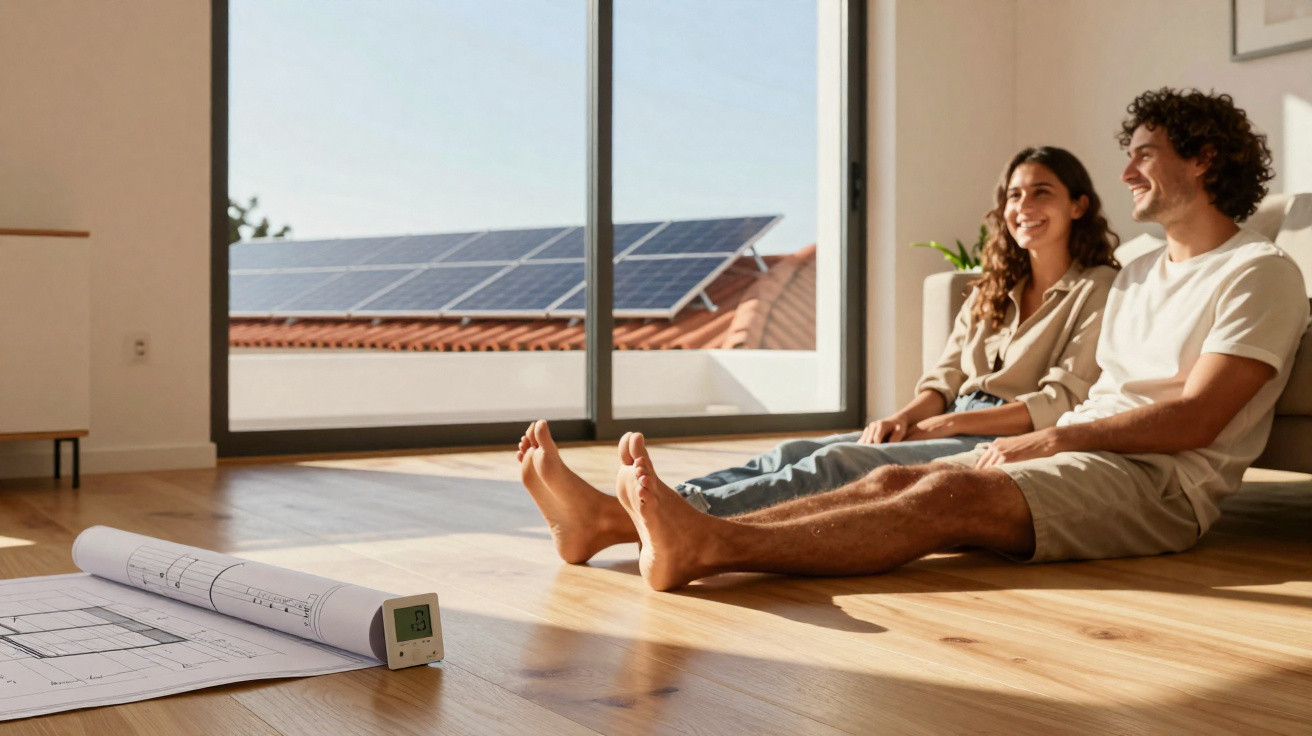
Indoors, the cost of keeping warm keeps rising. Between that and the weather outside, a low-key shift is changing how homes can be heated.
With winter bearing down across Europe and North America, plenty of households are turning the thermostat up and seeing the monthly charges rise with it. At the same time, a newer wave of solar-powered heating setups is aiming to deliver comfortable rooms without chunky radiators, rumbling boilers or that familiar jolt when the gas bill lands on the doormat.
A heating system with no radiators in sight
It can sound like sleight of hand: a house heated through winter with nothing mounted on the walls. In reality, the approach is straightforward, pairing rooftop solar panels with highly efficient controls and-often-underfloor heating so that daylight is converted into soft, even warmth.
Rather than burning gas or relying on plug-in electric heaters, photovoltaic (PV) panels produce electricity from the sun. That power is then used to run low-temperature heating elements, heat pumps or intelligent underfloor systems that absorb heat and release it steadily across broad surfaces.
Sunlight becomes electricity on the roof, then heat under your feet – with no traditional radiators and far lower running costs.
What really makes it work is the surface area involved. When floors, structural slabs, or purpose-built panels concealed in walls or ceilings are warmed, the system can operate at far lower temperatures than standard radiators while still keeping rooms pleasant. Simply moving to low-temperature heat can slash energy demand.
From bright idea to practical “solar central heating”
Solar panels have been commonplace for lights and household electrics for years. The newer move is to design them as the primary engine of a home’s heating, rather than a helpful add-on.
How the setup works in practice
A typical system brings together several core parts:
- Photovoltaic panels on the roof or façade generate electricity whenever there is daylight.
- An inverter turns that electricity into usable power for home systems, including heating.
- A smart controller decides when to prioritise heating, when to run other loads, and when to store energy.
- Thermal storage-often a hot water cylinder, a concrete slab or phase-change materials-keeps heat for later use.
- Underfloor or panel heating distributes the stored warmth evenly through the building.
This arrangement is often referred to as “solar central heating”, despite the absence of a conventional boiler. In effect, the building fabric becomes a slow, steady heat emitter.
Once the system is installed and paid off, the marginal cost of each extra degree of warmth can fall close to zero.
Why this “future heating” is attracting attention
Clean energy with no flue and no fumes
Most traditional heating systems depend on something being burned-gas, oil or wood pellets. Each kilowatt of heat therefore comes with emissions and often contributes to local air pollution. A solar-led system avoids combustion altogether.
PV panels generate electricity without producing emissions at the point of use. Combined with electric heating or a heat pump, the setup can remove the need for a flue, a gas supply connection or fuel deliveries. In crowded cities trying to meet air-quality targets, that is a meaningful advantage.
No gas line, no fuel tank, no chimney – and virtually no emissions during operation.
On the darkest winter days, homes will still draw electricity from the grid unless they have unusually large panel and storage capacity. Even so, generating a portion of power on-site can still cut a household’s carbon footprint substantially.
Numbers that make accountants smile
The financial case can be just as compelling. With radiators, gas boilers or direct electric heaters, every hour of warmth requires bought energy. In a solar-based setup, the main “fuel”-sunlight-does not have a price tag.
Evidence from European pilot schemes indicates that, once the upfront costs have been spread over time, day-to-day running costs can be far lower than with conventional heating. In homes that are designed well, heating-related bills may drop by 60–90%, depending on climate and local electricity tariffs.
| Heating type | Main energy source | Typical running costs | Local emissions |
|---|---|---|---|
| Gas boiler with radiators | Fossil gas | High and volatile | Yes, at home |
| Direct electric radiators | Grid electricity | High in most countries | Depends on power mix |
| Pellet stove | Compressed wood pellets | Moderate but rising | Particles and smoke |
| Solar-powered underfloor | Solar PV + electricity | Low once installed | Very low on site |
The main sticking point is the initial spend. Panels, inverters, controls and underfloor heating usually mean a larger outlay than simply replacing an ageing boiler with a newer model. However, support schemes and declining panel prices are starting to reduce the difference.
Why underfloor heating makes the difference
Heat where people actually feel it
Standard radiators primarily heat the air close to the unit, which can create warm spots near the radiator and cooler areas elsewhere. Underfloor heating works in another way: it warms the entire floor at a modest temperature, typically 25°C to 30°C.
Because warmth naturally rises from the floor, people can feel comfortable even if the room’s air temperature is slightly lower than it would be with radiator heating. That small change can reduce the energy needed for the same sense of comfort.
Instead of blasting a few metal panels to 60°C, the system gently heats a large surface to a much milder level.
In practice, this tends to produce more uniform temperatures, fewer draughts and-according to many occupants-a nicer quality of heat, especially in bathrooms and living spaces with hard flooring.
Design freedom for architects and renovators
Removing radiators also releases valuable wall area. It might sound minor, but it can reshape how interiors are laid out. Furniture placement is no longer dictated by bulky heaters; glazing can extend nearer to floor level; and narrow hallways stop becoming runs of radiators.
For new-build homes, the heating can be built straight into the slab or screed from day one. Retrofitting is usually trickier because floors may need lifting or opening up, though thinner underfloor products designed for renovation projects are becoming more common.
Who stands to gain the most from radiator-free heating?
At present, solar-driven heating tends to suit particular properties and locations best:
- New low-energy houses with high levels of insulation and strong airtightness.
- Detached or semi-detached homes with sufficient roof space for PV panels.
- Areas with cold but sunny winters, where clear days can still generate significant electricity.
- Households thinking long-term, able to wait several years for the investment to pay back.
Where roof area is limited-such as in dense urban blocks-or where shading is heavy, the solar share may be lower. In those settings, hybrid systems are already widespread, with solar working alongside a back-up boiler or an especially efficient heat pump.
What about cloudy days and freezing nights?
No heating option performs under ideal conditions all year round, and solar-powered systems are no different. Extended periods of overcast weather reduce PV output, and after dark the panels generate nothing.
That is where storage and intelligent management become essential. When the sun is available, the system can “charge” a thermal store-whether that is a hot water cylinder, a substantial concrete slab or specialised storage materials. The stored heat is then released gradually into the home once the sun goes down.
Think of the house as a rechargeable thermal battery: it soaks up heat when the sun shines, and lets it out when frost hits the windows.
In colder regions, most systems still retain another heat source: a heat pump connected to the grid, a small boiler, or even a contemporary wood stove. The aim is typically not to remove back-up entirely, but to reduce how often it has to run.
Key terms worth unpacking
Photovoltaic versus solar thermal
Two solar technologies are often confused. Photovoltaic panels use semiconductors to turn sunlight into electricity. Solar thermal collectors, on the other hand, heat a circulating fluid directly-usually water or a water/antifreeze mixture.
The radiator-free approaches described here rely mainly on photovoltaics because electricity can be used in several ways: to run a heat pump, power appliances and export surplus to the grid. Some projects pair PV with solar thermal as well-particularly for domestic hot water-to capture as much free energy as possible.
Heat pump synergy
A heat pump does not conjure heat out of nowhere; it transfers it, much like a refrigerator operating in reverse. Using electricity to move heat from the outdoor air or the ground into the home, it can provide three to five units of heat for every unit of electricity used when conditions are favourable.
If that electricity is partly generated by solar panels, and the heat is delivered through low-temperature underfloor heating, the efficiencies compound. Less energy needs to be bought, the PV output is used more effectively and occupants get a steady, comfortable indoor climate.
Future scenarios: how this could change daily life
Picture a winter morning in a near-future suburb. Overnight, the underfloor slab has slowly given off warmth captured from the previous afternoon’s sunshine. Indoors, the temperature stays even, without the familiar rhythm of radiators clicking on and off.
As daylight strengthens, the roof panels start supplying the home. A controller notices the living-room floor has cooled slightly and provides a gentle boost. It also delays the washing machine until lunchtime, when solar generation is expected to be higher.
For the household, the change is largely invisible. There is no loud burner, no scalding grille, no blue pilot flame to keep an eye on-just quiet, consistent warmth and an annual bill that is far less painful.
For renters and people in flats, the transition is more likely to happen at building scale. Developers are already trialling shared roof arrays feeding centralised heat pumps and underfloor heating for whole blocks. Residents pay a stable, predictable heating charge, while owners recover installation costs over a long period.
Challenges remain: gaps in policy, high upfront spending and a limited pool of qualified installers. Still, with energy prices moving unpredictably and climate targets becoming stricter, heating without conventional radiators is moving from a futuristic idea to a practical assumption in many places.






Comments
No comments yet. Be the first to comment!
Leave a Comment