
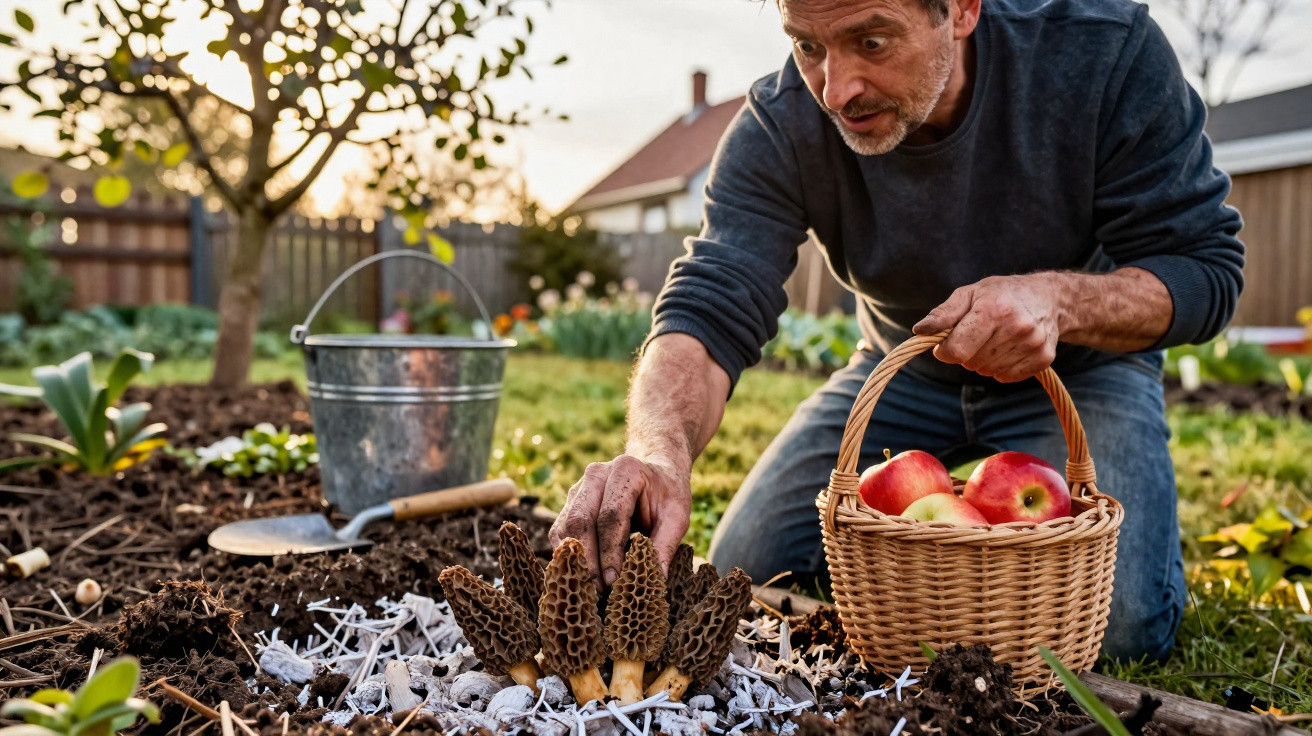
Morels are considered a luxury ingredient: scarce in the wild and expensive to buy. Every spring, plenty of mushroom enthusiasts spend hours walking woodland paths and still return with empty baskets. That is exactly where a surprisingly straightforward garden approach comes in: using fireplace ash and apple leftovers, you can create a spot where this elusive delicacy has a much better chance.
Why morels are so prized - and so hard to find
Morels are among Europe’s most aromatic edible mushrooms. Their nutty, intense flavour makes them a standout in the kitchen. At markets, prices can quickly rise - depending on the year - to well over €80 per kilogram, and dried morels are often even more costly.
In the wild, morels appear mainly in spring, typically in lime-rich, fairly open habitats - often near ash trees, fruit trees, or around old fire sites. Finding them takes experience, timing, and, above all, luck. Even seasoned foragers come up with barely any worthwhile quantities in many years.
"Morels aren’t ‘impossible to cultivate’ - they simply have extremely precise requirements for soil, climate and nutrients."
Those requirements can be recreated deliberately in a garden. The essentials are: alkaline soil, steady moisture, partial shade - and a particular kind of organic waste that many households produce anyway.
The unexpected stars: apple scraps and fireplace ash
You don’t need any high-tech kit to establish morels outdoors. What matters is a dedicated bed - often called a “morel bed”. Here, a pairing has been discussed increasingly in agricultural mycology in recent years: wood or fireplace ash combined with apple press residues.
In practice, that means two very simple materials:
- Wood ash from a stove or fireplace, fully cold, with no firelighters or paint/varnish residues
- Apple scraps from juicing or cider-making - the pulp left after pressing, without the juice
The apple leftovers contribute sugars and pectins that the morel mycelium can use to build up its reserve structures. The ash pushes the pH upwards and mimics natural “burn sites”, where morels often show up.
Location, soil, timing: how to make a garden morel-friendly
Choosing the right spot
A partially shaded area works best, for example:
- beneath an older apple tree or another deciduous canopy
- not in a hollow where water sits for long periods
- with loose, humus-rich soil and some lime content
Beds in full sun dry out too quickly, while deep shade under dense conifers is usually too acidic and too cool. A lightly shaded edge of an orchard often matches what morels need remarkably well.
The best time of year to set it up
Preparation usually begins in autumn, most often between October and November. At that point the soil has not yet frozen, rainfall helps distribute nutrients, and the fungal network can settle in before winter.
Step-by-step: how to create a morel bed
For a typical morel bed, an area of around 1 to 2 square metres is sufficient. You can go larger, but what matters most is following the method carefully.
- Loosen the soil: Lightly dig over the top layer or loosen it with a garden fork, removing thick roots and stones.
- Add an organic layer: Spread a layer several centimetres thick made from apple scraps and leaves. If you don’t produce your own apple leftovers, ask at a local cider press.
- Apply the ash layer: Scatter 2–3 cm of cold, clean wood ash evenly across the surface - thin, but continuous.
- Inoculate with morel spores: Either crumble overripe morels and work them in, or make a “spore water” (rinse morels in water and pour that liquid over the bed). Alternatively, ready-made mycelium kits can be used.
- Mulch lightly: Add a thin layer of leaves. This shields the mycelium from drying and cold without suffocating the soil.
"Ash plus apple scraps create a kind of ‘garden burn site’ that morels interpret as a signal to grow."
From this point on, keep the area as undisturbed as possible. Don’t hoe it, don’t dig deeply - only loosen the surface gently if a crust becomes too compact.
Water, temperature, “cold shock”: how to nudge morels into spring mode
Once the bed is prepared in autumn, winter does its work below ground. The mycelium forms reserve structures that later produce the fruiting bodies. Over winter, the bed needs:
- consistent, light moisture
- no waterlogging and no long-lasting pooling after heavy rain
- protection from severe ground frost using leaves or a thin mulch layer
In late winter or very early spring - around March - comes the interesting part. Many hobby gardeners then try an artificial “snowmelt effect” by watering the bed generously on a mild day using very cold water. That temperature cue imitates thawing snow, which morels often respond to in nature.
Depending on the region, the first mushrooms may appear between March and May. In cooler areas it can be much later; in very mild winters, it may be earlier.
How long does it take before the first morels appear?
Anyone setting up a morel bed will need patience. Even when all conditions are right, there is always an element of unpredictability. Some gardeners see nothing in the first year and then, in the second spring, suddenly get several flushes.
"Morels can be temperamental - a well-made bed only improves the odds; it can’t promise anything."
A typical timeline after setting up in autumn:
- First spring: fruiting bodies are possible, but not guaranteed.
- Second spring: successes are reported more often if the bed has remained stable.
- Further years: with regular care, morel beds can produce for several seasons.
When harvesting, cut the mushrooms just above the soil surface. That keeps the substrate undisturbed so the mycelium can continue working.
Long-term care: turning waste into an ongoing delicacy
To stop the bed fading after a single season, it needs a small top-up each year. In autumn, the following mini routine works well:
- spread a thin layer of apple scraps over the existing bed
- sieve a fine layer of wood ash on top
- cover again with leaves
This creates a repeating cycle: apple waste and stove ash don’t go in the bin; they go into a bed that, ideally, produces high-quality edible mushrooms. If you already heat with wood and have fruit trees, it’s a tidy way to close the loop in your own garden.
Health, safety, common pitfalls: what to watch out for
Even with all the enthusiasm, there are a few points worth taking seriously.
Not all ash is the same
Only ash from untreated, natural wood belongs in a morel bed. Painted furniture, treated construction timber, paper briquettes, or coal briquettes may contain heavy metals and chemicals. Those substances have no place in a vegetable or mushroom bed.
If you’re unsure, use much smaller amounts of ash and mix it in thoroughly. A pH that is too high can harm other garden plants if the bed sits too close to ordinary beds.
Risk of confusion at harvest
Morels have poisonous lookalikes, such as the false morel. If you are harvesting mushrooms for the first time, you should learn the identifying features carefully or ask a qualified mushroom expert. Even in a dedicated morel bed, a different fungus can settle in.
Typical mistakes in a morel bed
- The bed is too sunny and dry - the mycelium retreats.
- Too much water - waterlogging can rot the fungal network.
- Ash applied too thickly - the soil becomes almost sterile and unattractive to the mycelium.
- Frequent digging - destroys the fine fungal threads.
What makes morels so special - and what they go with
Once you finally hold your first home-grown morels, it becomes obvious why they have such a reputation. The flavour is so concentrated that small amounts go a long way. Classic pairings include:
- in a cream sauce with pasta or poultry
- in a robust creamy soup
- as a topping for risotto or polenta
- finely chopped in scrambled eggs or an omelette
Before cooking, fresh morels should always be cooked thoroughly, as they are not well tolerated raw. Dried morels should be soaked before use, and the soaking water adds extra depth to many sauces.
If you get the taste for it, you can try similar methods for other mushrooms - for example, oyster mushrooms on logs or shiitake on hardwood blocks. Morels remain the diva of the mushroom world: demanding and unreliable, but with an aroma that can make all the effort feel worthwhile.

Comments
No comments yet. Be the first to comment!
Leave a Comment