
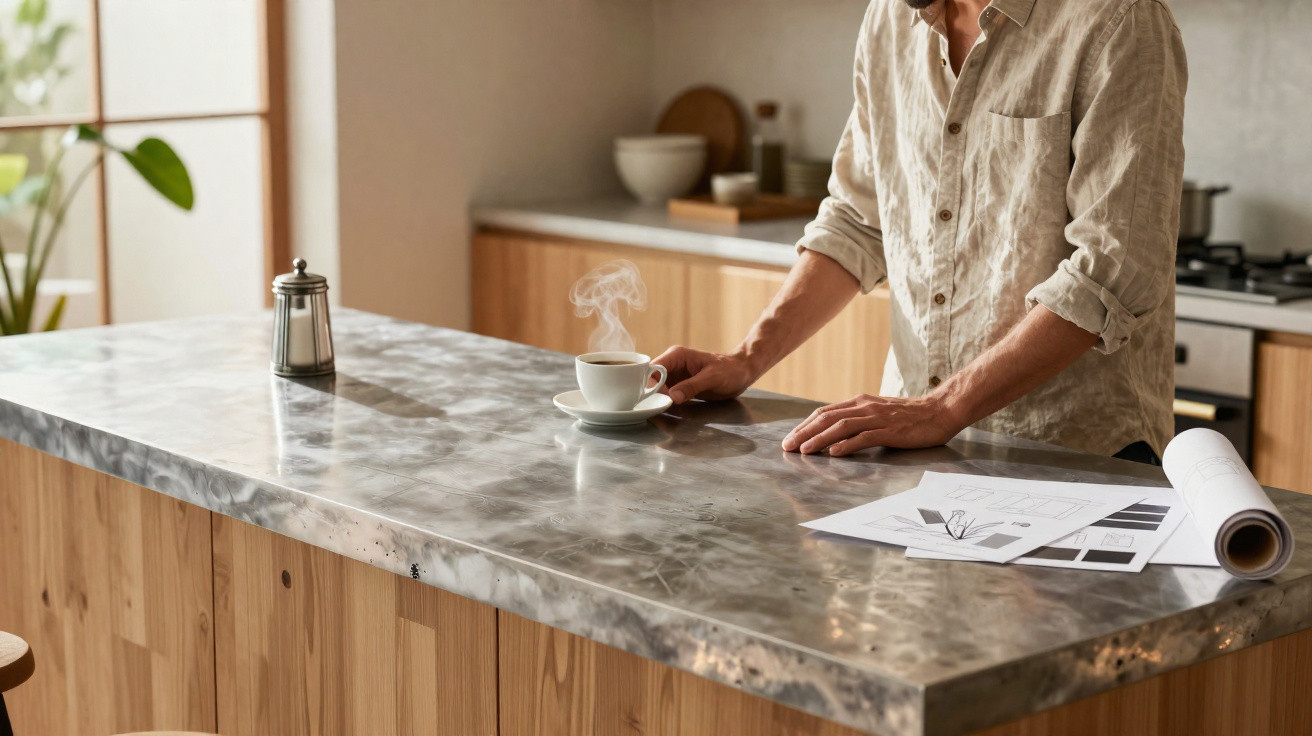
The worktop used to be little more than a hard-working surface - a practical slab you didn’t think about. In 2026, it’s expected to carry atmosphere, personal history and design intent. And the material currently catching designers’ eyes isn’t marble or quartz, but a traditional metal once synonymous with European café life.
The zinc comeback: from Paris café counter to 2026 statement piece
Mention zinc and many people picture dull-grey roofs shining after rain, or standing for a quick espresso “at the bar” in a compact Paris café. Historically, that bar was often zinc. For years it functioned as a shared perch for everyone - workers, students and night owls - all resting on the same cool metal edge.
Now that familiar surface is reappearing in contemporary kitchens in London, New York and further afield. Designers who want depth and personality, rather than showroom shine, are increasingly choosing zinc worktops to soften the sterile feel of all-white cabinetry and endless quartz islands.
Zinc counters reintroduce something kitchens have quietly lost: a lived-in, social, almost public energy in a private room.
A handful of trends are driving the return. Many homeowners are worn out by interiors that look interchangeable from one Instagram reel to the next. The preference is moving away from flawless polish towards materials that mellow with time and openly show use. Zinc suits that shift perfectly: it pushes back against the idea that a kitchen should look permanently brand new.
Its gentle blue-grey colouring also matches today’s more understated take on luxury. Zinc doesn’t shout, but it picks up winter light with a soft, smoky reflection. In homes filled with screens and sharp LEDs, that quiet sheen feels especially welcome.
A “living” material that refuses to stay pristine
Zinc doesn’t perform like engineered stone. It doesn’t disguise wear. It doesn’t act as though nothing ever happens in the kitchen. Instead, it records it.
Almost immediately, the surface starts to evolve. Fingerprints lose their crispness, water spots blur, and fine scratches merge into an emerging patina. For some people that’s alarming at first; for many others, by the six-month mark, it becomes the main attraction.
Every stain and scratch on a zinc countertop slowly fades into a soft patina, turning daily mess into long‑term character.
As the metal naturally oxidises, its colour shifts subtly. Areas that see less action tend to stay cooler and greyer, while the places you chop vegetables or set down your morning coffee drift towards warmer, smokier tones. Designers describe zinc as “alive” not as a flourish, but because it never truly stops changing.
Practical strengths that suit real-life kitchens
Alongside its atmosphere and heritage, zinc brings a set of functional benefits that suit busy homes:
- It resists corrosion when properly installed.
- It is naturally hostile to many bacteria, which helps keep prep zones hygienic.
- It feels slightly warmer to the touch than stainless steel.
- It can be folded, welded and shaped for seamless sinks or curved edges.
Day-to-day care is straightforward: use a soft cloth with warm water and a mild soap. Harsh scouring powders are counterproductive - they simply create more scratching. Acidic spills such as lemon juice, vinegar or wine can leave pale marks if left in place. Some owners minimise this with coasters and chopping boards; others see those traces as part of the finish developing.
For families, that change in attitude can be freeing. Rather than guarding a glossy stone surface from every accident, they let the metal take on the evidence of birthdays, hurried breakfasts and late dinners.
Industrial edge, cosy heart: how designers are using zinc now
Choosing zinc again doesn’t mean turning your home into a 1910 bistro. The current approach blends a slightly industrial feel with warm, domestic elements. Designers also tend not to install zinc everywhere. More often, they use it as a focal point - an island, a breakfast bar, or a single run of worktop that visually grounds the room.
A few combinations are showing up repeatedly in 2026 kitchen schemes:
- Pale timber units: Cabinets in oak, ash or maple sit quietly beneath a zinc top. The wood tempers the metal, and the metal keeps the timber from reading as overly rustic.
- Deep, saturated fronts: Zinc paired with forest green, inky blue, charcoal or terracotta doors gains a subtle shimmer. The contrast adds richness without relying on high-gloss shine.
- Textured glass and handmade ceramics: Ribbed glass, stoneware jugs and imperfect tiles work well with zinc’s subdued reflection, giving the kitchen a more crafted, lived-in feel.
Lighting is part of the equation too. Above a zinc island, warm pendants hung low tend to bring out its soft reflections. Cold, intense spotlights can make the surface look flat and draw attention to small marks - something most owners would rather avoid.
Costs, imitations and smart compromises
Made-to-measure zinc worktops are rarely a cheap choice. They involve metal sheets, careful folding, welding and on-site installation, often carried out by roofers or metalworkers applying their expertise indoors. Costs vary a great deal depending on country, thickness and edge detailing.
For anyone keeping a close eye on spending, there are increasingly convincing substitutes. High-pressure laminates can mimic aged zinc using printed textures and slightly matt finishes. Another option is bonding a thin zinc layer onto an existing worktop, updating the look without a full refit.
| Option | Look | Budget level | Patina over time |
|---|---|---|---|
| Solid zinc sheet on plywood | Authentic, cool to the touch | High | Yes, genuine evolving patina |
| Zinc veneer on existing top | Very close to real zinc | Medium | Yes, but slightly thinner effect |
| Zinc-look laminate | Visual imitation only | Lower | No real patina, fixed pattern |
Ultimately, it comes down to what matters most. If the appeal is the worktop’s unpredictable, changing surface, genuine metal is usually the point. If it’s mainly the colour and industrial mood you want, laminate - and its consistent look - may be enough.
Things nobody tells you before you choose a zinc worktop
Behind the romance, zinc comes with a few realities. It’s softer than stone, so dents are easier to make. Drop a heavy pan and you may see a shallow impression. Many owners treat that as part of zinc’s narrative; anyone chasing perfect uniformity may find it challenging.
Heat brings another caveat. Zinc copes with warm plates and brief contact with hot cookware, but frequent, intense heat can cause discolouration. Trivets and boards still have a role. It also marks easily: using knives directly on the worktop will leave visible lines, and most metalworkers strongly recommend proper chopping boards for food preparation.
Choosing zinc means accepting marks, soft dents and colour shifts as features, not defects.
For some households, that acceptance fits a wider change in how homes are used - less like display spaces, more like places that hold memories. For others, a tougher surface such as sintered stone will remain the better fit.
Why the zinc revival fits the 2026 mood so well
Zinc’s return is a good indicator of where home design is heading. After years of fast furniture and trends that flip every season, many people are looking for slower, steadier choices. They’re drawn to materials that stay in place, age openly and feel a little individual.
Zinc speaks directly to that outlook. It doesn’t claim it will remain unchanged; it quietly promises the opposite. That idea resonates with people cooking more at home, entertaining more often, and treating the kitchen as the main social space rather than just a prep area.
It also matches a gentle move away from the “show kitchen” approach, where everything disappears behind handle-less fronts. With zinc, the worktop becomes part of the story. Visitors notice it, ask about it, and instinctively run a hand across the cool, textured surface. The countertop becomes a talking point, not an empty backdrop.
How to test if zinc really suits your lifestyle
Before committing to several metres of worktop, many designers recommend trying zinc on a smaller, lower-risk piece first. A sideboard top, a slim breakfast bar, or a freestanding console clad in zinc can serve as a real-world trial over a few months.
That test period quickly reveals how you feel about marks, spills and tonal shifts. Some people grow attached to the evolving finish; others discover they prefer something more predictable. Either way, the experiment can prevent wasted money and disappointment.
If you like mixing surfaces, another option is to combine zinc with wood or stone within the same kitchen. A zinc island for sociable cooking, alongside tougher perimeter worktops near the hob, can deliver a practical balance between charm and durability.
In the coming years, that blended approach is likely to appear in many refurbishments. The metal once associated with bustling café counters is returning - quietly but assuredly - to everyday homes, ready to take on years of meals, spills and conversation across its soft, shifting surface.



Comments
No comments yet. Be the first to comment!
Leave a Comment