
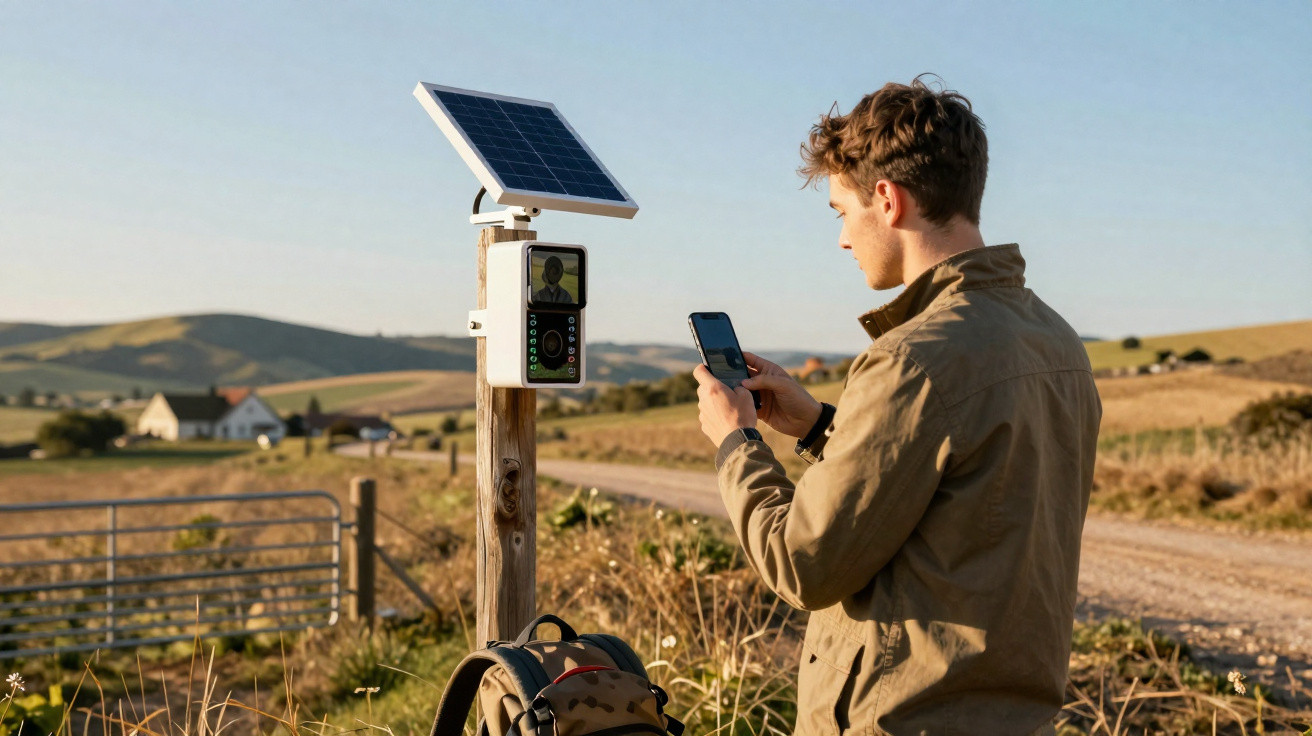
Anyone with a woodland weekend cabin, an out-of-the-way allotment plot or a large pasture knows the problem: no Wi‑Fi, often no mains socket - and conventional cameras tend to fail in exactly these places. With the Ezviz EB8 Pro Ranger, the brand is aiming to fill that gap by pairing 4K video, mobile data and a solar panel in a setup that deliberately looks different from the usual white plastic “eyes” stuck to a house wall.
Solar camera with 4G: monitoring without a socket or Wi‑Fi
The EB8 Pro Ranger is clearly designed for locations where there’s neither power nor a reliable home network. Instead of the standard approach - “camera on the exterior wall, cable to the socket, connection into the home network” - Ezviz is going for a largely self-sufficient concept.
- Power supplied via an included solar panel
- 4G mobile module for areas without Wi‑Fi
- An additional Wi‑Fi 6 module for places where a network is available
- 4K resolution for detailed footage
The EB8 Pro Ranger can operate independently of a mains socket and home router - a clear advantage for meadows, woodland plots or remote building sites.
At the centre of the setup is hybrid connectivity: the camera either connects to your home network over Wi‑Fi 6 or uses a 4G mobile connection. Depending on how you set it up, the device switches to whichever system is available, with the aim of keeping remote access working even when the internet connection is a long way from the installation point.
Camouflage look instead of a white tech box
One thing that stands out is the design. With the Ranger, Ezviz moves away from the familiar white “tech brick” and opts for natural tones and a textured finish that feels closer to camouflage than smart home styling. The idea is for the camera to blend into hedges, trees or shrubbery rather than draw attention.
That approach is aimed at owners who want to secure land without making it obvious where the hardware is positioned. On larger plots - such as orchards, riding arenas or hunting grounds - a discreet appearance can be a genuine benefit. And it’s not only about security: anyone wanting to observe animals without immediately startling them also gains from the low-profile look.
AI detects people, vehicles and animals
On the technology side, Ezviz is leaning heavily on automated detection. The camera uses AI to analyse images, with the goal of cutting down false alerts and opening up additional use cases.
Filters for relevant events
According to the manufacturer, the EB8 Pro Ranger can tell the difference between:
- People
- Vehicles
- Up to 21 commonly found animal species
In everyday use, that means you can decide exactly what the camera should react to. If you only care whether someone enters the property at night, you can ignore animal movement. Conversely, you can set things up so animal activity becomes the focus - for example around a chicken run or on a paddock.
The camera isn’t just suited to traditional security scenarios; it also works for animal keeping and wildlife observation - without constant false alarms every time a cat darts past.
Animal recognition is also interesting for farmers and smallholders: if a pen is regularly visited by foxes or martens, event patterns can help you track it. That, in turn, can make it easier to decide where fencing should be reinforced or where housing needs extra protection.
Always-On Video: near-continuous recording
With AOV 2.0 (Always-On Video), Ezviz moves closer to conventional continuous video surveillance. Rather than only recording when motion is detected, the EB8 Pro Ranger captures footage at extremely short intervals - in the most extreme setting, every second.
This reduces gaps between individual motion clips and can make it easier to reconstruct what happened on a property more completely. For remote building sites or storage areas, that can be crucial if someone slowly approaches outside a typical motion zone.
The trade-off is a much higher volume of data. Ezviz offers two storage options:
- Local storage on a microSD card up to 512 GB
- Cloud storage via the Ezviz CloudPlay service (subscription required)
If you plan to use Always-On mode, it’s worth thinking carefully about how long recordings need to be retained, and whether local cards will need regular backups or swaps. For many people, a combination may make sense: key incidents stored in the cloud, with longer-term archiving on the card.
Siren, strobe light and two-way talk
Despite the emphasis on blending in, the camera can become very assertive when it matters. If the system identifies an unwanted person, you can trigger a loud siren and a bright strobe - either automatically or manually from the app.
There’s also a two-way talk feature. Using the built-in microphone and speaker, you can speak directly to anyone in front of the camera - from a quick “You are not authorised to be here” to communicating with delivery drivers or tradespeople on the site.
Audible alarms, light signals and two-way talk turn a hidden camera into a highly visible security tool the moment you need it.
In most cases, these functions can be configured in detail within the app. That’s useful, for instance, if a farm has animals moving around at night and you don’t want sirens going off, while a remote residential plot might benefit from a stronger deterrent effect.
GPS module for large areas
Unusual for a security camera, Ezviz includes a GPS module. On a basic level, it helps you find the camera again across very large sites - anyone placing several Ranger units throughout woodland will know how quickly a camouflaged housing can “disappear” into undergrowth.
GPS may also be relevant in the event of theft. If a camera is taken, there is at least a chance of tracing its last known position. For costly devices installed in publicly accessible areas, that’s a meaningful advantage.
Who is the EB8 Pro Ranger worth it for?
With an asking price of 299,99 Euro including the solar panel, the camera sits in the premium bracket. It’s less aimed at a typical terraced-house balcony and more at people with specific requirements:
- Owners of holiday homes without a fixed internet connection
- Farmers, horse owners and small animal breeders
- Gardeners with large or hard-to-reach land
- Businesses with remote storage yards or construction sites
- Hunters and nature enthusiasts who want to monitor wildlife movement
For standard smart home use, the combination of 4K, 4G and solar power will often be more than you need. But for anyone who previously had no practical option because power and Wi‑Fi weren’t available, this offers an approach that can cover many areas that would otherwise remain unprotected.
What buyers should check before installing
Before buying, it’s sensible to clarify a few points. First, mobile coverage on the land is crucial. A 4G camera won’t help much if the signal drops out in a dip behind the trees. Testing with your own smartphone at the intended mounting position provides a useful initial indication.
Second is the placement of the solar panel. Only with adequate sunlight can the camera run off-grid long term. In dense woodland or in the shadow of large buildings, that becomes more difficult. In those cases, it may be worth mounting the panel slightly further away where it gets better sun exposure.
Third, consider privacy and the legal framework. Even if you are monitoring remote private land, you still need to ensure you’re not permanently filming public paths or neighbouring property. A camouflaged camera is subject to the same rules as an obvious model fixed to a house façade.
Why cameras like this are becoming more important
As the number of second homes, allotments and hobby-used plots rises, so does demand for flexible surveillance. Traditional alarm systems and hard-wired installations often don’t suit land that is only visited a few times a month. Battery-powered cameras with solar panels and mobile connectivity are designed to bridge that gap.
The EB8 Pro Ranger is a good example of a wider shift: away from smart home gadgets tethered to fibre broadband, towards robust tools for places where video surveillance previously wasn’t even considered. Used sensibly, this kind of tech can reduce theft risk, help protect animals and keep an eye on day-to-day activity across large areas - without needing to be on site all the time.



Comments
No comments yet. Be the first to comment!
Leave a Comment