
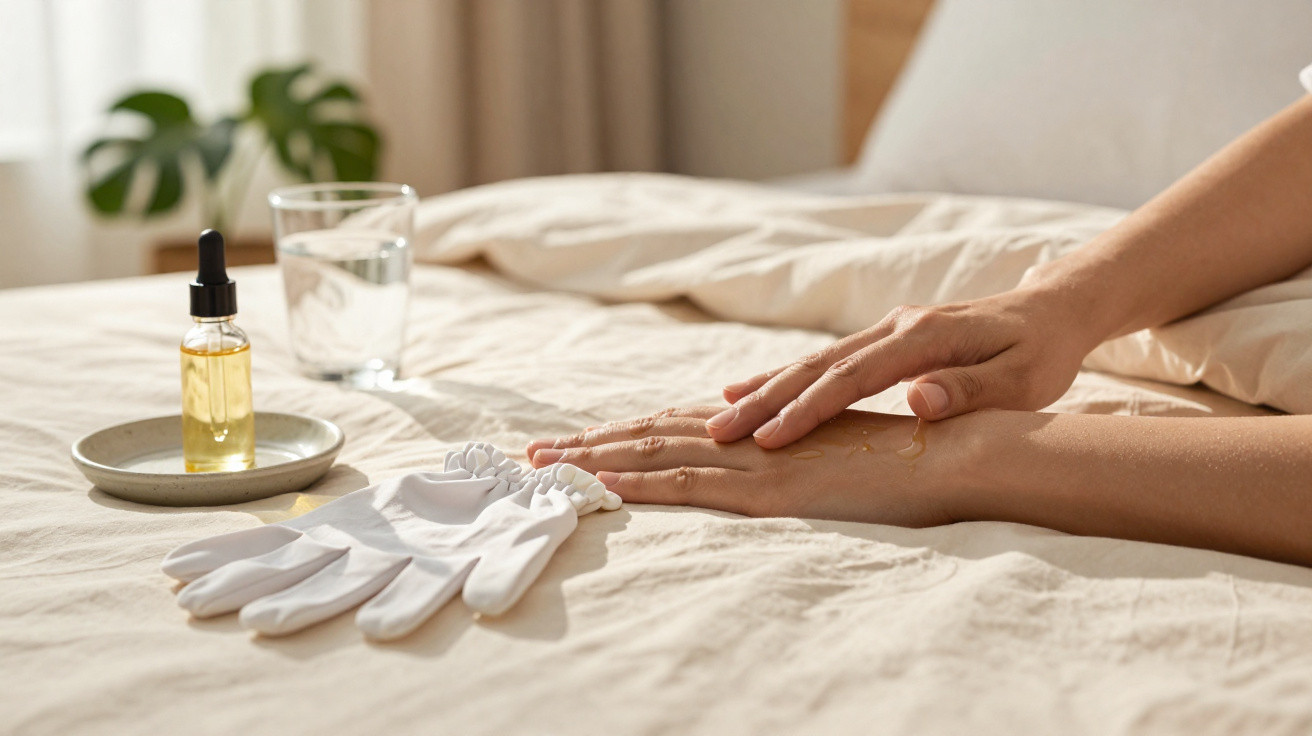
Applying oil and cotton gloves before you go to sleep can ease dryness, roughness and that tight, stretched feeling in your hands. The oily layer helps limit water loss from the skin’s surface, while the fabric keeps the moisturiser in place overnight and stops it being rubbed off on sheets and pillows.
Why does this care help dry hands?
Skin acts as a barrier, protecting the body and helping to prevent excessive water loss. Frequent handwashing, harsh soaps, alcohol-based products and degreasers strip away some of the skin’s natural lipids, which can leave hands rougher, more sensitive and more prone to small cracks. How well the skin barrier is functioning is also closely linked to how effectively it can hold on to moisture.
Coconut oil, almond oil, rich creams and petroleum jelly can all create a film over the area. Petroleum jelly usually provides the strongest occlusive effect, while plant oils mainly work as emollients-smoothing surface irregularities and temporarily improving softness.
How do cotton gloves extend hydration?
Gloves do not make the product sink endlessly into deeper layers of skin. Their key role is to keep the oil or cream in contact with your hands for several hours, reduce transfer onto bedding, and protect the skin barrier from friction while you sleep.
- Keep moisturiser spread across fingers and palms
- Reduce how much product is removed overnight
- Lessen contact between nails and sheets or other surfaces
- Help control how much oil ends up on the bed
- Make it easier to repeat the habit as part of a regular routine
Who is most likely to benefit from this technique?
This approach is often helpful for people who wash their hands many times a day, work with water, or regularly handle detergents, soaps and degreasing products. These products dissolve grease, but when used repeatedly without suitable gloves, they can also remove the skin’s protective components.
If your hands are very dry, you may repeat the routine on around five nights per week or for several days in a row-provided you do not develop itching, stinging or redness. There is no one “correct” frequency: deep cracks, bleeding, persistent flaking or inflammation call for appropriate assessment rather than increasingly intensive applications.
How to apply the oil before putting on the gloves
Your hands should be clean and slightly damp, because applying product soon after washing helps trap some of the water sitting on the surface. Use a thin layer, so your fingers and palms are not excessively slippery:
- Wash your hands with a mild soap and warm water
- Pat dry without rubbing, leaving a little moisture
- Apply a few drops of oil or a thin layer of petroleum jelly
- Massage into fingers, backs of hands, palms, nails and cuticles
- Put on clean cotton gloves that are completely dry
- Remove the gloves in the morning and wash them after a few wears
- Patch test first when using a new or fragranced product
Night-time care should be paired with protection during the day
Moisturising at night does not stop new irritation from happening. For tasks involving detergents and cleaning products, waterproof gloves reduce direct contact with irritants. After washing your hands, reapplying a fragrance-free cream helps prevent the skin from staying dry until your next night-time routine.
Night-time care for hands and nails can also be supported by using sunscreen on your hands during the day-especially after washing and before prolonged exposure. This routine tackles two separate needs: oil or cream to reduce dryness, and protection against radiation that contributes to dark marks and ageing in the area.






Comments
No comments yet. Be the first to comment!
Leave a Comment