
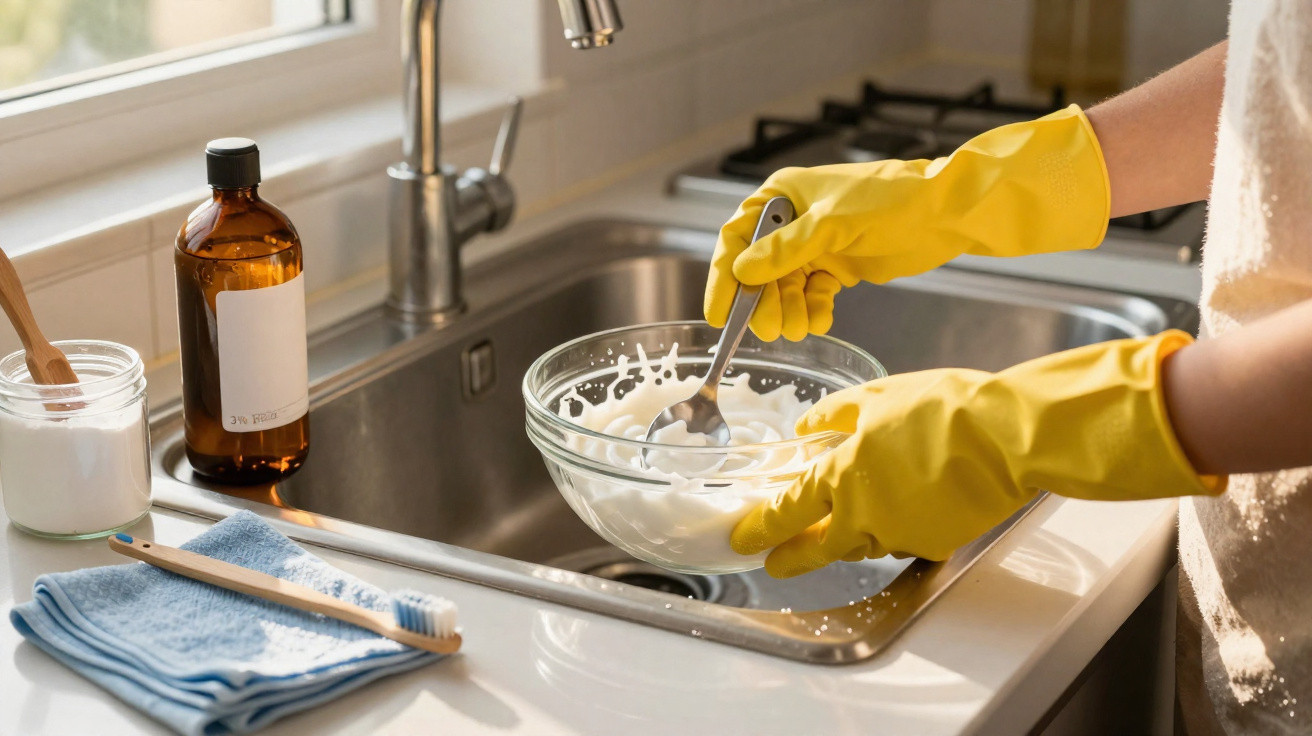
A paste made from bicarbonate of soda and hydrogen peroxide is often used in household cleaning to loosen stuck-on grime and brighten certain stains. Bicarbonate of soda offers gentle abrasion, while hydrogen peroxide works as an oxidising agent. Used together, they may help on grout, sanitaryware and white items, but you should test first to avoid fading or scratching the surface.
What happens when bicarbonate of soda and hydrogen peroxide are mixed?
Bicarbonate of soda creates a grainy, alkaline base that increases contact with dirt as you scrub. Hydrogen peroxide, meanwhile, can oxidise some pigments and organic residues, which can support the brightening of hard-wearing surfaces. The most common household option is a 3% concentration, also labelled as 10 volumes.
You may see bubbles as the peroxide starts to break down and release oxygen. That fizzing can help lift surface residue, but it does not, by itself, prove the area has been disinfected. Because an alkaline environment can speed up decomposition, the paste should be mixed only at the time of use and not stored for later cleaning.
Why has this paste become popular for household cleaning?
Its thick texture makes it easier to keep the ingredients on grout lines, corners and vertical areas for a few minutes. It also combines two effects in a single application:
- Bicarbonate of soda helps remove dirt mechanically.
- Hydrogen peroxide can brighten stains of organic origin.
- The paste stays where it is applied for longer.
- The texture can reach narrow gaps with the help of a soft brush.
- The ingredients are easy to find in pharmacies and supermarkets.
Which surfaces is the mixture commonly used on?
The best-known use is on dirty, darkened grout in ceramic-tiled floors and walls. The paste can also be tried on white toilets and other white sanitaryware, tiles, porcelain sinks, and white trainer soles-always taking the finish into account and following the manufacturer’s guidance.
On stainless steel, any rubbing should follow the direction of the brushed finish and be done gently, as the granules can leave marks. For trainers, keep the product only on hard-wearing white areas, and avoid coloured fabrics, leather, suede and glued sections that may discolour.
How to apply it without damaging the surface
Add a small amount of 3% hydrogen peroxide to bicarbonate of soda little by little until you get a firm paste. Safe use depends more on testing first and applying gently than on scrubbing hard:
- Test it first on a hidden patch.
- Wear gloves and keep the area well ventilated.
- Apply the paste only to a cool surface.
- Leave it for just a few minutes, without letting it dry out completely.
- Scrub with a soft brush or a non-abrasive cloth.
- Rinse and dry thoroughly after cleaning.
- Do not keep leftovers in sealed containers.
Which surfaces and combinations should be avoided?
This mixture is not recommended for marble, polished natural stone, unsealed wood, aluminium, painted surfaces, delicate finishes or coloured materials. Both the oxidising action and the abrasion can cause uneven lightening, loss of shine, wear to protective coatings or visible scratches.
This cleaning paste should also not be mixed with bleach, ammonia, vinegar or other products. Preparing it on its own-using low-concentration hydrogen peroxide and applying it immediately-helps reduce risk and allows you to use this bicarbonate-and-peroxide method at home without compromising sensitive surfaces.

Comments
No comments yet. Be the first to comment!
Leave a Comment