
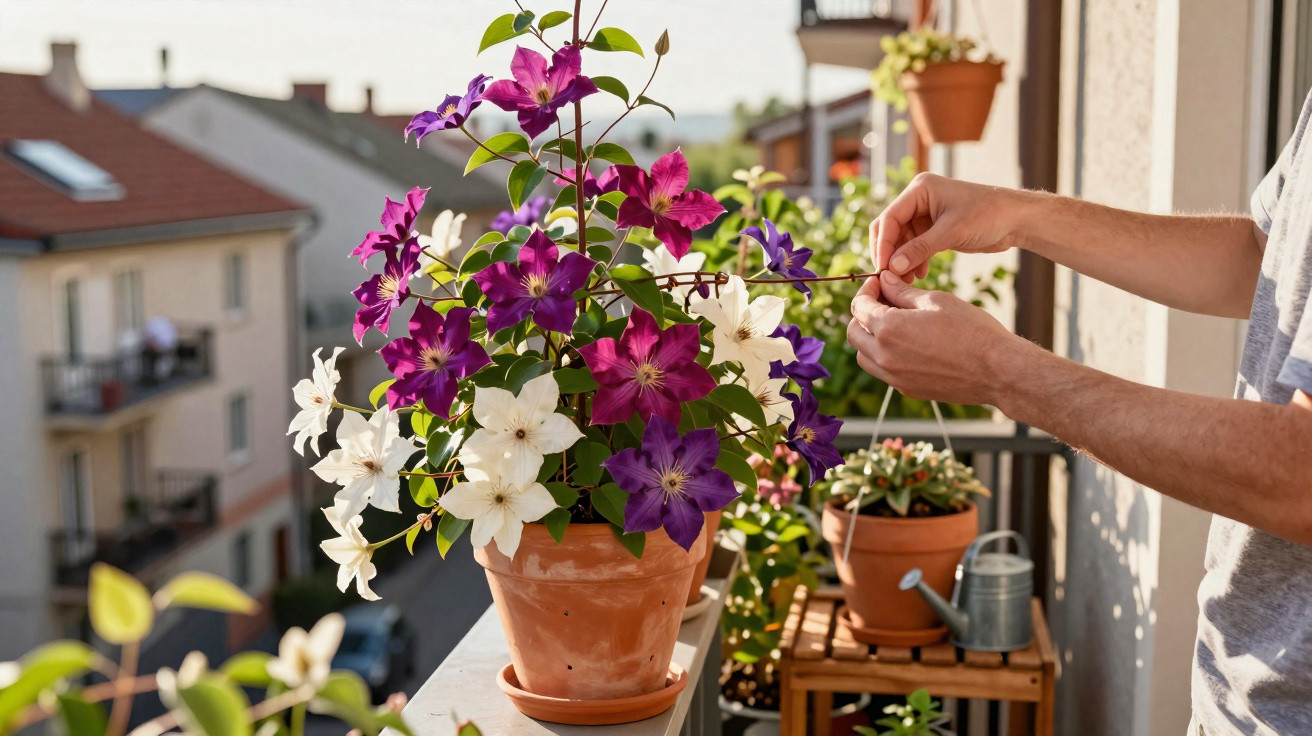
With the right climbing plant, that is exactly what you can achieve.
Anyone living in a city knows the issue: ground space is limited, tubs get in the way, and traditional shrubs quickly feel too bulky. In tight courtyards and on narrow balconies, every extra pot can start to look like an obstacle. That is why a particular group of compact climbing plants relies almost entirely on height - turning slim corners into dense walls of flowers without stealing your usable floor space.
Why compact climbing plants rescue small gardens
In small urban gardens, every square centimetre matters. Rather than spreading outwards, there is a straightforward approach: garden vertically. Climbing plants make use of existing surfaces such as walls, fences, or railings and give the eye something it can “travel” upwards along. The result is that a space that was essentially a rectangular concrete box can suddenly look and feel like a genuine garden.
Compact varieties are especially interesting because they are bred to stay small. They typically reach only 1–2 metres, yet they still cover the entire support neatly. Flowers appear from the bottom right up to the top, so you are not left with bare stems in the middle. On a tiny balcony, the effect can resemble a living picture.
"The idea: instead of lining up ten pots across the space, use one large container - and stack the flowers vertically."
There is another benefit as well: the area feels larger. When plants grow upwards, the floor remains clear. You see more greenery without feeling as though you have to squeeze through a jungle. For compact city loggias, that is invaluable.
Dwarf clematis: full flowering impact in very little space
Among compact climbing plants, low-growing clematis cultivars have become something of a benchmark. They are specifically bred for pots, small gardens, and narrow courtyards, and they do not require tall pergolas. A low fence, a small trellis, or a simple frame is enough.
Typical features of these mini forms include:
- a growth height of just 1–2 metres in most cases
- very dense foliage with hardly any bare patches
- flowers starting close to the soil and continuing up to the tips
- large blooms like classic clematis, but on a compact plant
Visually, the choice is broad. Some varieties show white petals with a pink-toned central marking; others shift from a soft blue to pure white; and some set strong pink against dark façades. That makes them ideal for disguising dull walls, grey concrete surfaces, or uninspiring privacy panels.
Using colour deliberately
A dark inner courtyard benefits from bolder shades. Rich pink or violet stands out well against brickwork and concrete features. Lighter tones such as white or pastel blue, by contrast, suit modern pale façades and enhance an airy look.
Flowering duration is also crucial in an urban garden. Many compact clematis varieties flower for weeks, and some do so in waves. That keeps the space attractive for a long time - particularly when the balcony effectively becomes a “second living room” in summer.
The right pot: big enough and well-drained
If you want a container-grown plant to become a true flowering star, the pot matters. A container that is too small dries out too quickly, while one with no drainage holes holds water like a bath - both situations put the roots under stress.
A useful rule of thumb is:
- at least about 30–35 cm in diameter
- sufficiently large drainage holes in the base
- a layer of expanded clay or coarse gravel for drainage
- high-quality, loose-structured compost for containers
A combined planting of the main plant with companions can help a lot: low-growing or gently trailing flowers around the rim shade the surface. That keeps the roots cooler and also disguises a plain-looking pot.
"If the roots are kept cool and evenly moist, clematis repay you with noticeably more flowers."
Narrow balconies, windowsills, hanging baskets: how to use every corner
Not every climbing plant has to reach upwards. There are clematis types that grow more like small, bushy plants, stay only a few decimetres tall, and look excellent in hanging baskets. Their stems spill elegantly over the edge and move in the breeze - covered in dense, colourful bell-shaped or star-like flowers.
These forms suit:
- railings on narrow balconies
- windowsills fitted with hanging baskets
- wall hooks beside the front door
- covered entrances and patio canopies
Over the months, they keep producing fresh blooms; later, decorative seed heads appear and bring a different kind of appeal. Even in late summer, when many other plants begin to tire, these cultivars still add structure and character.
Climbing support, watering, feeding: keeping the flower wall in shape
For a compact climber to become a genuine wall of flowers, it needs reliable support. Slim trellises, bamboo canes, wire systems, or metal frames work well, either placed directly in the pot or fixed to a wall.
Clematis will wrap their leaf stalks around thin supports by themselves. With thicker structures such as balcony railings, it helps to tie in young shoots loosely with plant ties. That allows you to guide growth where you want it, helping the wall fill out evenly.
When watering, aim for consistency - but avoid constant soaking. Waterlogging is harmful, and so is letting the compost dry out completely. In pots, it is easy to check: feel the compost with your finger; if the surface is dry, water, and if it is still moist, wait.
Feeding plays a key part in generous flowering. From the moment the first buds appear, a potassium-rich feed - for example, a tomato fertiliser - used in measured amounts encourages more blooms. Shortly before flowering starts, it can be worth stopping feeding: that slight “stress” often prompts the plant to set even more flowers.
"Feed sparingly, but with purpose: it does more than constantly topping up nutrients."
On hot days with temperatures clearly above 25 °C, the leaves may temporarily turn yellow. That does not automatically mean something is wrong; it often signals a brief resting phase. During this time, do not drown the roots. Keeping the compost lightly moist is enough, and the plant will recover.
Avoiding care mistakes: what harms compact climbers
With limited space, it is tempting to use very small containers. For many clematis, that is precisely what causes stress. Too little compost volume heats up strongly, dries out fast, and holds fewer nutrients. The result is short, weak shoots and very few flowers.
A fully shaded spot with no sunlight at all is also unhelpful. Most climbing bloomers prefer their leaves to receive light while the root area stays cool and partly shaded. Harsh midday sun on the rim of the pot can be moderated easily with companion planting.
Locations that work particularly well
In practice, three situations have proved especially successful:
- East- or west-facing balcony: sun in the morning or evening, shelter at midday - ideal for container growing.
- Narrow courtyards with a bright wall: reflected light provides enough brightness without scorching heat.
- A loggia with an open edge: airy, but not completely exposed - sturdy climbing frames can be integrated well here.
Added value for climate, calm, and neighbours
Beyond appearance, compact climbing plants bring other advantages. They provide habitat for insects, visually soften hard façades, and improve the microclimate on a balcony. A greened surface heats up less than bare concrete, and the air feels fresher.
They also create a sense of privacy: a planted support in front of the railing reduces views from opposite buildings without needing to install a solid screen. Neighbours are more likely to appreciate a flowering wall than a grey plastic panel.
If you enjoy experimenting, you can combine compact clematis with other climbers - for example, delicate sweet peas, low-growing nasturtiums, or small-growing ivy. This creates layered displays that change character across the season. Even the smallest city balcony can become a vertical mini-garden project that brings pleasure for most of the year.



Comments
No comments yet. Be the first to comment!
Leave a Comment