
There’s a thin green seam along the drive, the kind that makes it look as though the outdoors is quietly taking back ground you thought you’d claimed. It starts as a few shoots, then turns into a proper little battalion of driveway weeds wedged into the joints, seemingly unfazed by your last “big clean-up weekend”. You come home with the shopping, spot them, and feel that quick flicker of defeat. You yanked them out only weeks ago. You even bought that spray you swore you wouldn’t touch. And somehow they’re back again - tougher than before.
Later on, as the kettle whistles in the kitchen, you find yourself scrolling through a gardening thread on your phone. Someone suggests boiling salt water. No chemicals, no sprayer, and apparently it goes right down to the root. Your thumb pauses over the screen. Could the solution to those stubborn driveway weeds really be sitting in the cupboard?
Why those driveway weeds always come back
On a warm Saturday morning, your driveway can look almost fine from a few steps away - just a sprinkle of green between the pavers. Up close, it’s another story: mini dandelions, tough strands of grass, squat plantains wedged into hairline splits. They may look flimsy, but they hold on with surprising force. Tug at one and the top often breaks away, leaving a pale root anchored deep beneath the slab.
You tip the sad little stems into the bin, already aware of what’s coming next. Give it a week or two and the very same crack is hosting fresh leaves again, as if the weeds are quietly pleased with themselves. It can start to feel oddly pointed - like they’re testing how long you’ll put up with them. That low-level annoyance outside your front door says a lot about the way we try to keep nature “tidy”.
A London homeowner I spoke to hit his limit after a wet spring. He’d cleared his block-paved drive three times in two months, and every time the growth returned. He tried hand-pulling, scraping with a knife, and even going at it with a pressure washer. The moss disappeared. The weeds stayed put. “I gave in and bought a weedkiller spray,” he admitted. “The smell was awful. And my dog walks across that path every day.”
So he started searching late at night, flicking through gardening subreddits and local group chats. Among all the usual advice, one suggestion kept popping up: boiling water with a decent handful of table salt. Pour it directly over the weeds in the cracks. No branding, no hazard labels - just basic kitchen stuff. It sounded almost too simple. Yet the photos people shared were hard to ignore: browned stems, clean joints between slabs, and no regrowth for weeks.
Behind the slightly dramatic before-and-after shots, the mechanics are fairly straightforward. Boiling water scorches plant tissue, effectively shocking it so the cells collapse. Salt then seeps into those weakened tissues and into the surrounding grit and soil. That interferes with the plant’s water balance, drying it out from the inside. The key is that the heat helps the salt travel down through the stem, so you’re hitting the root as well as whatever’s showing above the surface.
That’s also why simply pulling weeds often feels pointless. Most of the time you’re removing what you can see, while the root system stays protected beneath the paving. Shop-bought weedkillers go after those roots chemically. Boiling salt water is a DIY equivalent - strong enough, when used carefully, to deal with more than the visible green.
How to use boiling salt water on driveway weeds
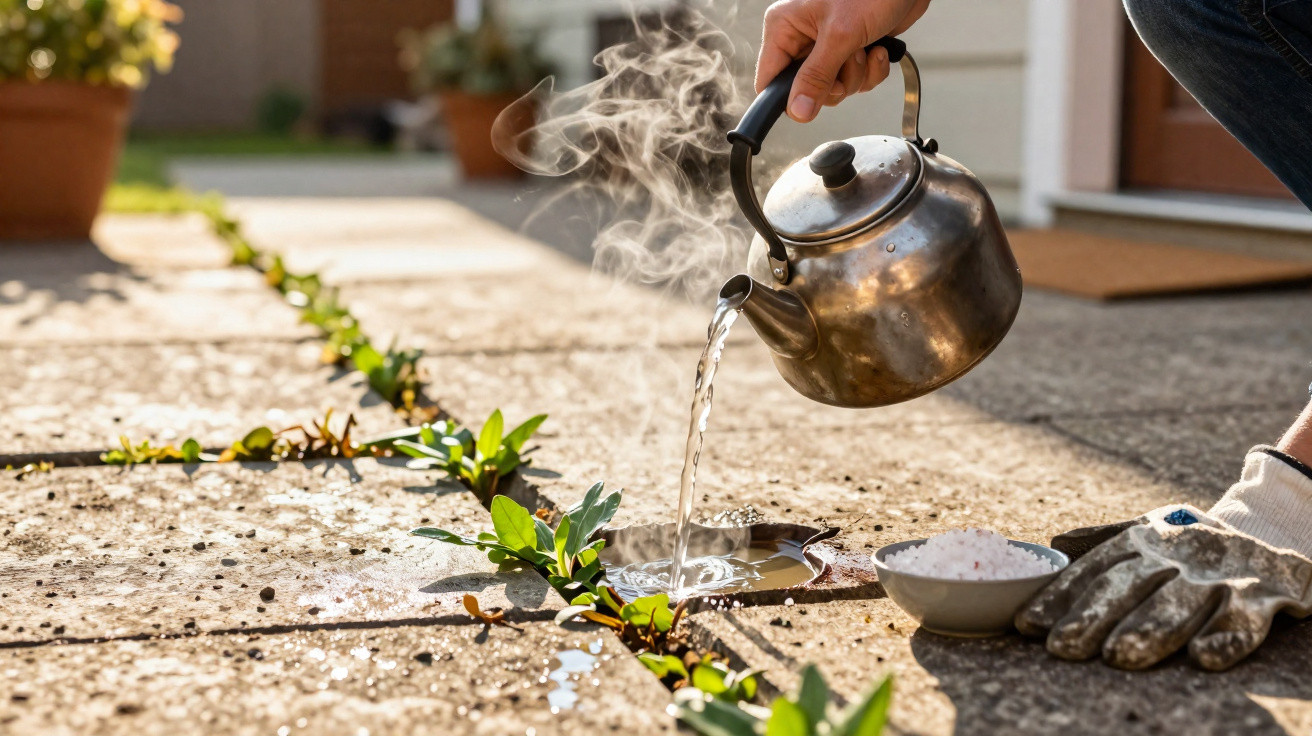
The approach is uncomplicated - and, in a satisfying way, decisive. Use ordinary table salt. Tip a generous amount into a pan of water - around one heaped tablespoon per litre is a sensible starting point for light growth. Stir until it dissolves, then bring it up to a vigorous boil, like you would for pasta. The temperature matters as much as the salt.
Once you’re outside, work steadily along the drive. Pour the boiling salt water straight into the cracks where the weeds are growing. Try to target the base of each plant rather than flooding a wide area. Do it in small sections so the water is still properly hot when it lands. Then leave it alone - no scrubbing, no pulling. Within 24–48 hours, you’ll usually notice the weeds turning yellow and slumping.
Some people increase the salt, particularly for thick, established weeds sitting in wider joints. If you double the salt, you’ll often get quicker, more dramatic browning. The trade-off is obvious: salt doesn’t stay neatly where you put it. Use too much and it can spread sideways through damp ground, damaging grass and nearby plants - anything that depends on healthy soil. That’s why driveways, paths and patios are the best places for it: hard surfaces, narrow cracks, and very little soil you’re trying to protect.
Be realistic about timing, too. You don’t need to patrol the driveway every weekend. Choose a dry spell - perhaps once at the start of summer, and then again if you notice a fresh wave coming through. Let’s be honest: nobody genuinely keeps on top of this every day. The point is to keep things under control, not to “win” against the outdoors.
There’s also a quieter, emotional piece people rarely admit to. Weeds can make you feel like you’re somehow failing at basic adult life. On a street of spotless drives, a few scruffy tufts can feel embarrassingly noticeable. When you’re already busy, they become just another demand on your attention. You’re allowed to want it easy. Boiling salt water appeals because it feels low-effort, low-guilt, and reliably effective.
“I wanted something I could do in ten minutes with the kettle on,” a reader told me. “No mask, no gloves, no worrying about the cat walking through a chemical puddle.”
Even so, a few gentle rules are worth following:
- Keep it to hard surfaces: driveways, paths and patios - not borders or beds.
- Start with less salt; repeat the treatment rather than overdoing it.
- Don’t pour near drains or anywhere runoff will head straight into the street.
- Keep children and pets away until the area has cooled and dried.
- Pair it with the occasional manual tidy-up for better long-term results.
A small ritual against chaos in the cracks
Once you’ve used it a couple of times, boiling salt water stops feeling like a “hack” and starts to resemble a small household ritual. Kettle on, pan ready, a quiet five minutes reclaiming the strip of paving outside the front door. It doesn’t mean you’ve become a full-time gardener. It’s simply a straightforward, non-toxic way of saying: this bit is mine. Nature can keep the rest - the verges, the street edge, the hedge at the back.
Some readers say it changes their mindset. The weeds stop being a source of wordless shame and become another repeating job, like wiping down the hob. We all recognise the moment a neighbour’s immaculate drive makes us look at our own with a twinge of guilt. A quick pour of boiling salt water won’t transform everything, but it shrinks the problem into something manageable - and strangely calming.
It also raises a broader question: how hard we work to keep nature at arm’s length, what we spray, what we tip away, and what ends up flowing into drains after heavy rain. A pan of boiling salted water isn’t the answer to every weed in every garden. It won’t replace better paving, decent drainage, or simply accepting a bit of green between the slabs. Still, it offers a quiet middle route: less plastic bottle, more kitchen cupboard; less harsh chemistry, more targeted common sense; a way to deal with that thin green line on the driveway without feeling you’ve struck a deal with something you don’t fully trust.
| Key point | Detail | Benefit for the reader |
|---|---|---|
| Targeted action | Pour boiling salted water directly at the base of the weeds in the cracks | Maximises effectiveness without wasting time or effort |
| Non-toxic alternative | Use salt and water instead of a chemical weedkiller spray | Reduces exposure for family, pets and the environment |
| Simple routine | Treat 1 to 3 times per season, depending on regrowth | Keeps the drive looking tidy without sacrificing every weekend |
FAQ:
- Does salt water kill the weeds permanently? It can kill the existing weed right down to the root, especially on younger plants, but seeds in the cracks can still sprout later - so you may need to repeat it a couple of times a year.
- Will the salt damage my driveway? Salt water doesn’t usually harm concrete or paving stones themselves, although repeated heavy use over time can corrode nearby metal fixtures or edging.
- Is it safe for pets and children? Once the water has cooled and dried, it’s generally safe - but you don’t want children or pets walking through hot water, or licking salty puddles while it’s fresh.
- Can I use this near my lawn or flower beds? You can, but only if you’re very precise; salt can spread through soil and harm grass or ornamental plants, so treat the cracks only and prevent runoff into planted areas.
- How salty should the water be? One tablespoon of salt per litre is a sensible starting point; if the weeds are stubborn, increase gradually rather than starting with an overly strong mix.



Comments
No comments yet. Be the first to comment!
Leave a Comment