
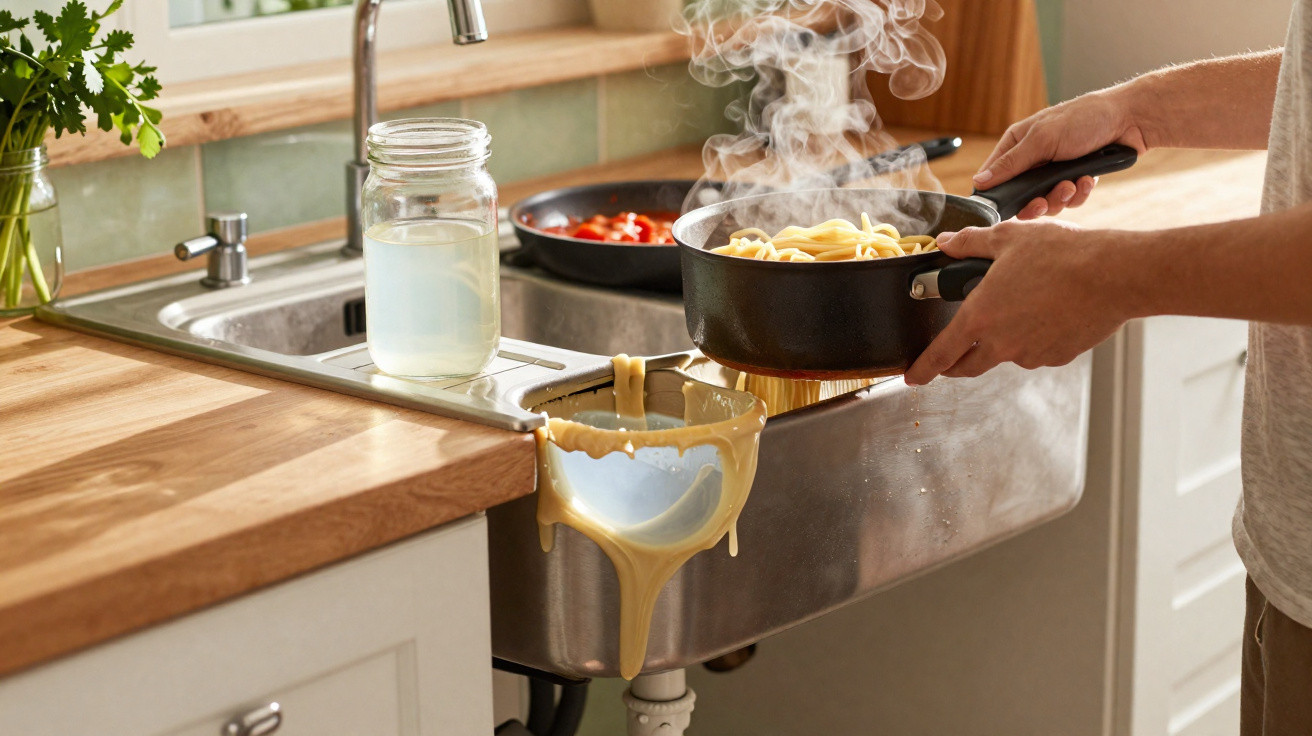
The scene is familiar: pan off the hob, lid held slightly ajar, a quick tilt - and the boiling-hot pasta water surges into the sink. Clean, fast, gone. The catch is that this everyday habit can quietly damage your kitchen over time, lead to expensive pipework issues, and strips pasta dishes of a key element professional chefs use as a matter of course.
A heat shock for your kitchen: when pasta water attacks the pipes
Most people pour pasta water straight from the boiling pan into the sink. The temperature is often just below 100 °C - and many kitchens simply aren’t designed for that.
Drain pipes made from PVC are particularly vulnerable, and they’re standard in many modern homes. This plastic can start to deform at around 60–70 °C. With boiling water, there’s barely any safety margin.
"Repeated heat shocks can soften PVC pipes, cause warping and, over time, lead to hairline cracks."
The damage rarely appears overnight. More often, it’s a slow, creeping process:
- Pipes warp slightly, especially around bends and joints
- Seals become brittle due to constant temperature changes
- Micro-cracks form, and water can seep unnoticed behind cabinets or into walls
It tends to show up at the worst possible moment: damp patches on the wall, swollen kitchen units, or a musty smell whose source is difficult to track down.
Metal pipework and sinks can suffer too
Even older installations using copper or steel aren’t necessarily in the clear. In those systems, the weak points are more likely to be at the connections. Cold water sits in the pipes, then suddenly near-boiling pasta water rushes through - that abrupt change puts stress on seals and joins.
The sink itself can also be affected. These are often the most sensitive:
- enamelled sinks, which can develop fine hairline cracks
- composite and resin sinks, which may discolour or become blotchy
- models where the manufacturer specifies a maximum temperature of around 80 °C
The frustrating part is that the consequences often only become visible much later. While you keep tipping it away “cleanly”, the heat is quietly working against your kitchen in the background.
An invisible sticky trap: how starch slowly clogs drains
Pasta water isn’t just hot water. It turns cloudy and milky because starch leaches out of the pasta. That same ingredient causes the second major issue: blockages.
When heated, starch swells and makes the water slightly slimy. In the drain, this mixture coats the inside of the pipework and leaves a thin, mildly sticky layer.
"The starch in pasta water acts like an invisible primer for anything that goes down the pipe afterwards."
What then tends to catch on it includes:
- small food scraps and crumbs
- bits of pasta, grains of rice, vegetable fragments
- soap and washing-up liquid residue
As long as the water still seems to drain reasonably well, nobody notices. Yet the build-up continues silently. What starts as a thin film gradually becomes a thicker ring that narrows the pipe more and more.
Add fat, and the film turns into a concrete-like plug
It becomes genuinely unpleasant once fats enter the mix: frying oil, leftover butter, creamy sauces. Many people assume boiling water dissolves grease and flushes it away. Briefly, that’s true - but the problem is simply shifted further along the pipe.
The fat melts in the hot water, travels some way down the line, and then reaches a cooler section. There it cools rapidly and solidifies again. That spot is often a bend in the pipe or another awkward, hard-to-reach area.
"Starch plus fat plus cold - that combination gradually creates tough, stubborn plugs in the pipe."
A common reflex is to pour even more boiling water down, or to reach for harsh chemical drain cleaners. Both put extra strain on materials and the environment, without addressing the underlying cause: too much heat, too much fat and too much starch going into the drain.
A wasted kitchen treasure: what pasta water can do while cooking
From a professional chef’s point of view, pouring it away is a tragedy. In the kitchen, pasta water is a quiet star.
The starch that becomes a problem in pipework acts in the pan as a natural thickener. It helps sauces turn creamy, brings ingredients together, and lifts pasta dishes to another level - without relying on heavy cream or convenience products.
"A small ladle of pasta water can turn a pale sauce into a silky, emulsified creamy sauce."
If you want pasta that tastes restaurant-level, use pasta water deliberately:
- Stir a little into tomato sauce so it clings to the pasta better
- Emulsify it with oil, Parmesan and seasoning to make “Aglio e Olio” or pesto smoother and more cohesive
- Toss day-old leftovers in a pan with a splash of pasta water to make them juicy again
The principle is simple: starch dissolves into the water, moves into the sauce, and gives it body and shine. At the same time, you can often skip additional thickeners such as flour or powdered sauce binders.
How much pasta water is sensible
You don’t need to save a whole pan. Just before draining, scoop out a mug or a ladleful and set it beside the hob. When you season the sauce, add it a tablespoon at a time until the texture is right.
A handy side effect: while the water waits in the ladle, it cools a little - and if any is left over, it won’t hit the drain at a full rolling-boil.
How to dispose of pasta water without harming your pipes
No one needs to make cooking complicated. A few small habit changes are enough to protect your plumbing - without having to juggle heavy pans.
Gentler options instead of a heat shock
- Pour the pan into a large bowl or a second saucepan, let it cool, then tip it away only when it’s lukewarm
- Run cold water at the same time as you pour, so the temperature in the pipe mixes immediately
- Before draining, lift out a ladleful of pasta water to use later
If you cook pasta often, you can also reuse some of the water for other tasks - for example, once cooled, to soak heavily soiled frying pans. The small amount of starch helps loosen baked-on residue.
Sensible maintenance instead of brute force in the drain
For everyday care, simple, gentle household methods are usually enough to stop starch and grease layers building up in the first place.
- Regularly pour a mix of lukewarm water (no more than about 50 °C) and coarse salt down the drain
- About once a month, sprinkle half a cup of bicarbonate of soda into the drain, follow with a little white vinegar, leave for 10–15 minutes, then flush through with warm water
"A classic rubber plunger is often more effective in an emergency than an ‘extra dose of boiling water’."
If you use the plunger early, you reduce the chance of a small blockage being pushed deeper into the pipework. One important detail: briefly cover the sink overflow so the suction can build properly.
What many people don’t realise: other uses for pasta water
Once you have it, pasta water can be put to work in more ways. A few examples that are still surprisingly uncommon in many kitchens:
- Cooled and used as a base for dough or a bread starter, because the starch adds structure
- As a gentle soaking liquid for pans with stuck-on pasta or rice
- In small amounts for soups and stews to lightly thicken them without changing the flavour
Anyone who cooks vegetarian or vegan benefits especially: pasta water brings creaminess without needing cream, cheese or egg. Light vegetable sauces, in particular, gain body this way.
Why it’s worth pausing before you pour it away
Once you think about it, the old reflex of tipping boiling pasta water into the drain suddenly doesn’t seem so clever. The mix of extreme heat, starch and fat works against your kitchen - and it also robs dishes of the chance to develop a better texture.
If instead you slow down briefly, hold back a little water for the sauce, and let the rest cool before disposal, you protect your pipework, reduce the risk of costly call-outs to drainage services, and raise your pasta to a new standard - a small change driven less by habit and more by awareness.



Comments
No comments yet. Be the first to comment!
Leave a Comment