
Three simple tricks can make your home feel noticeably warmer.
In many homes, winter turns into a minor drama: heating bills go up, yet the rooms still feel chilly. If you cannot afford to replace windows or pay for insulation straight away, you will look for quick, low-cost fixes. That is exactly where three physics-based tips come in, improving comfort by a clear margin – using items most people already have at home.
Why it can still feel cold even with the heating on
When temperatures drop outdoors, several issues often combine: poorly insulated walls, leaky windows, cold floors and radiators that send some of their heat in the wrong direction. The result is familiar: you turn the thermostat up, the bill rises, but you do not feel much more comfortable.
"If you understand how heat moves – through conduction, radiation and air movement – you can gain several degrees of comfort with just a few simple steps."
Physicists typically separate three key processes:
- Conduction: heat travels through solid materials, and also escapes outdoors through gaps, joints and cracks.
- Radiation: radiators emit heat in all directions, including into cold walls.
- Convection: warm air rises and cooler air falls, circulating heat around the room.
If you tackle these three points, you often do not need to set the heating nearly as high to feel noticeably more comfortable.
Trick 1: Seal smarter and keep the heat indoors
A portion of your heating simply leaks out through small gaps and seams. Cold air creeps under doors, whistles past window frames and creates draughts. That does not just reduce the actual temperature; it also lowers perceived comfort – even if the thermostat says a perfectly “normal” 20°C.
Where the usual weak spots are
The problem areas are almost always found in the same places:
- older timber windows with hardened or missing seals
- balcony or patio doors where you can see daylight through the gap
- the bottom edge of doors leading to hallways, cellars/basements or the front door
- uninsulated roller-shutter boxes and letterboxes
A quick check helps: hold your hand near the joints, or carefully move a tealight along the edges to see where the flame flickers most.
Simple measures that work immediately
The good news is that you do not need a big budget to deal with the worst leaks. Helpful options include:
- Self-adhesive sealing strips for windows and doors, cut to size with scissors.
- Door seals or draught excluders at floor level, such as foam strips or fabric “sausages”.
- Thick curtains over windows and external doors, ideally made from thermal fabric.
- Rugs on tiles or laminate, especially in living rooms and bedrooms.
"A heavy curtain and a thick rug can increase the perceived temperature near windows by up to two degrees – without touching the thermostat."
If you get cold feet easily, you will notice the change straight away: cold floors sap comfort dramatically. A wool or jute rug interrupts that chill effect, keeps your feet warm for longer and usually means you no longer need extremely high room temperatures.
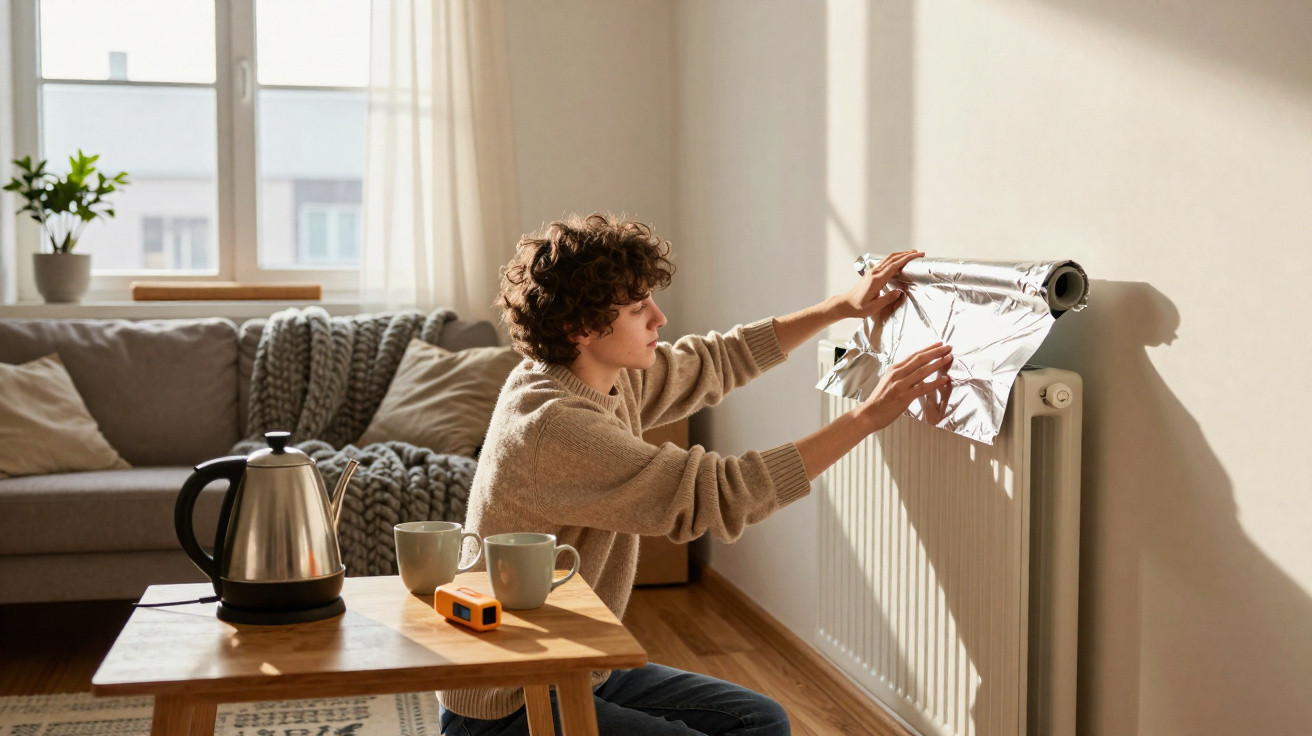
Trick 2: Upgrade radiators with aluminium foil
Many radiators are mounted directly in front of external walls. That means a significant share of the heat radiation effectively disappears into the wall. This is where an unexpected helper comes in: ordinary kitchen aluminium foil.
How the heat trick works in physical terms
A radiator releases energy not only by warming the air, but also as infrared radiation in all directions. When that radiation hits a cold external wall, the wall warms up, but the room air benefits far less. Aluminium reflects a large proportion of that radiation back into the room.
"Reflective surfaces behind the radiator can save roughly five to ten per cent of heating energy, depending on the building condition and the radiator’s position."
Step-by-step: make a heat reflector yourself
- Cut cardboard to match the radiator’s surface area.
- Cover it smoothly with aluminium foil or a space blanket, with the shiny side facing outwards.
- Place or hang the board behind the radiator, leaving a little gap to the wall so air can still circulate.
- Make sure nothing sits directly on hot surfaces and that there is no contact with electrical components.
You can also buy ready-made reflector panels made from rigid foam with an aluminium surface. They cost more than the DIY option, but they are sturdier and usually easier to fit, especially in rented properties.
When you should be cautious
This approach is best suited to traditional hot-water radiators on external walls. Keep these points in mind:
- Do not stick foil directly onto damp, mould-prone walls, as moisture can build up behind it.
- With modern, slim electric heaters, the benefit is often small; check the manufacturer guidance first.
- Do not leave loose foil hanging about – avoid fire risks and keep a safe minimum distance.
Trick 3: Use everyday heat sources more effectively
People, appliances and cooking give off more heat than many realise. A person at rest emits roughly as much power as an old-style light bulb. With several people in a smaller room, the temperature can rise noticeably.
Concentrate warmth instead of spreading it around
A practical idea is to group activities. Rather than spending the evening across several rooms, focus on one main living area. That is where the television, laptop and lighting will be running too – all small sources of heat. In a closed room, it adds up.
Cooking can also be used more strategically:
- After switching it off, leave the oven door open, as long as nobody can burn themselves.
- While cooking, keep doors to less-used rooms closed so the warmth stays where you are.
- Use pan lids when heating so energy goes into the food more quickly.
Kettle instead of hob – using energy wisely
For hot water, an electric kettle is often the better choice. It is usually more efficient than a hob because the heat goes straight into the water. If you boil only the amount you actually need, you save twice over.
| Use | Energy needed for 1 litre of water* | Typical mistake |
|---|---|---|
| Kettle | lowest | boiling too much water, not removing limescale |
| Hob | medium to high | pan too large, no lid, ring set too high |
| Microwave | often highest | long run time, unsuitable container |
*Indicative values, highly dependent on the appliance and how it is used.
"If you fill the kettle only halfway rather than to the brim, you can significantly reduce everyday electricity use – while making the same amount of tea or coffee."
You can also use leftover heat creatively: hot water can go into a hot-water bottle, a vacuum flask for later, or help with washing up. All of this contributes to feeling warmer day to day.
Mood and light: reinforcing a sense of warmth
There is also a psychological effect worth noting: warm, yellowish light makes rooms feel cosier than cool, white light. Modern LED bulbs around 2,700 Kelvin create that “candlelight” feel while using very little electricity.
If you set up a few warm-white light sources in the evening and place a couple of safe tealights in sturdy glass or ceramic holders, the room is naturally perceived as more snug. Important: never leave candles unattended and ventilate adequately, as they consume oxygen.
How to combine the effects sensibly
The biggest impact comes when you use all three approaches together:
- Seal draughty spots and slow down cold surfaces with rugs and curtains.
- Add reflective backing behind radiators so more heat stays in the room.
- Intentionally concentrate everyday heat sources such as cooking, people and lighting in one main room.
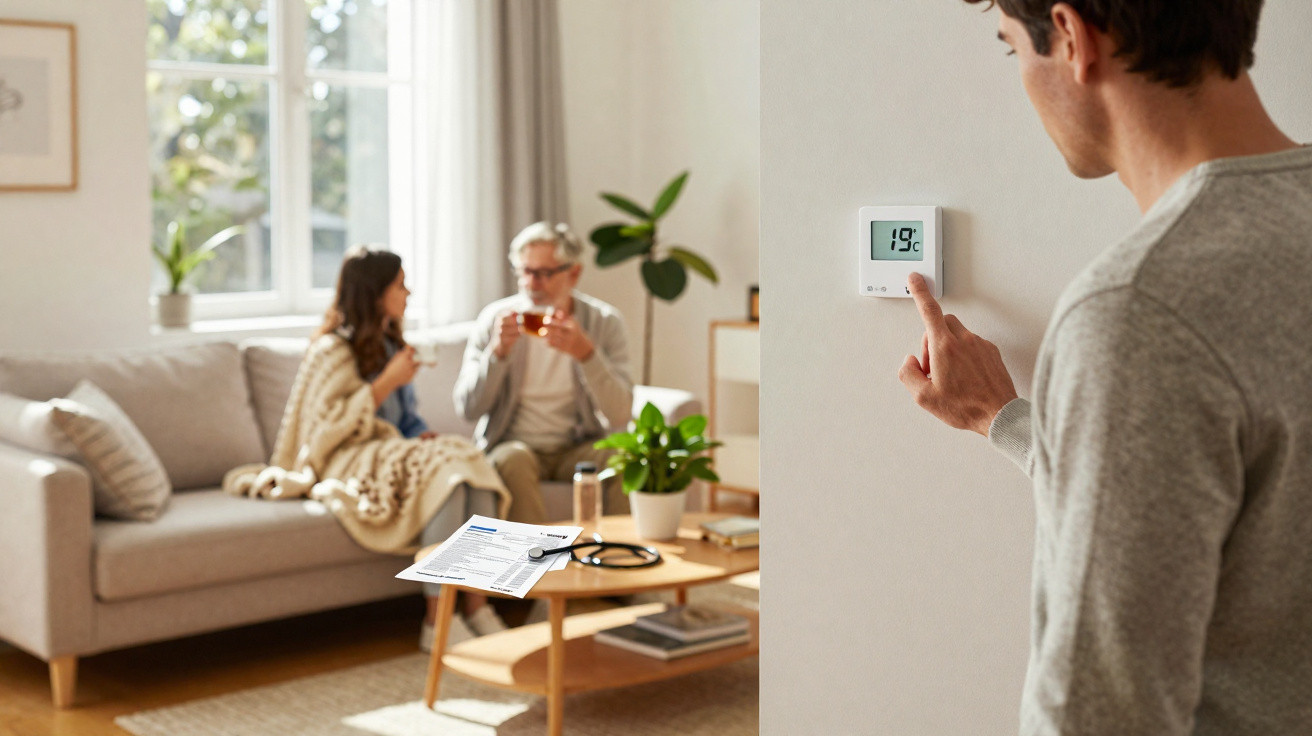
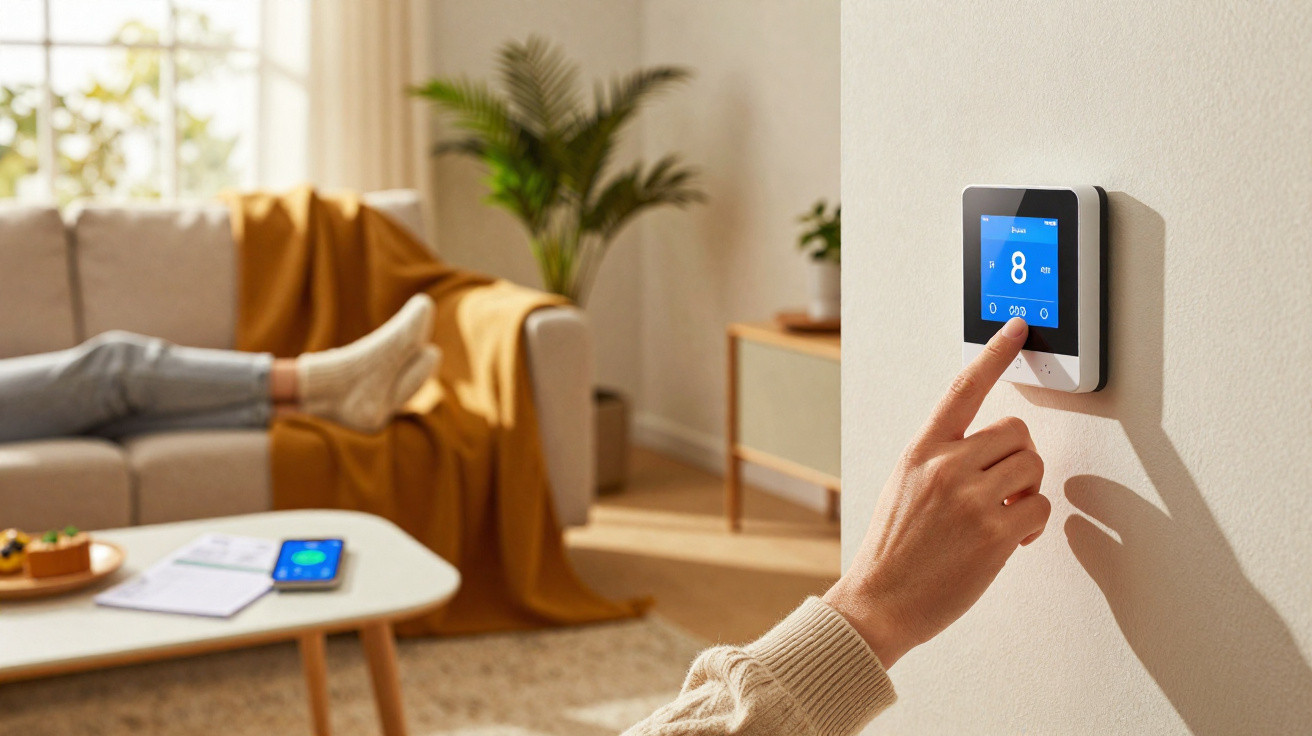
If you then set the heating a little lower, you can save real money and still enjoy a pleasant indoor climate. Dropping the thermostat by one degree means roughly 5 to 6% lower heating costs – and with consistent draught-proofing plus these tricks, that becomes much easier.
The older the building and the worse the starting condition, the more strongly you will feel the improvements. In modern, well-refurbished flats it is more about fine-tuning and comfort; in older properties, these measures can be the difference between “always freezing” and “finally cosy”.
Comments
No comments yet. Be the first to comment!
Leave a Comment