
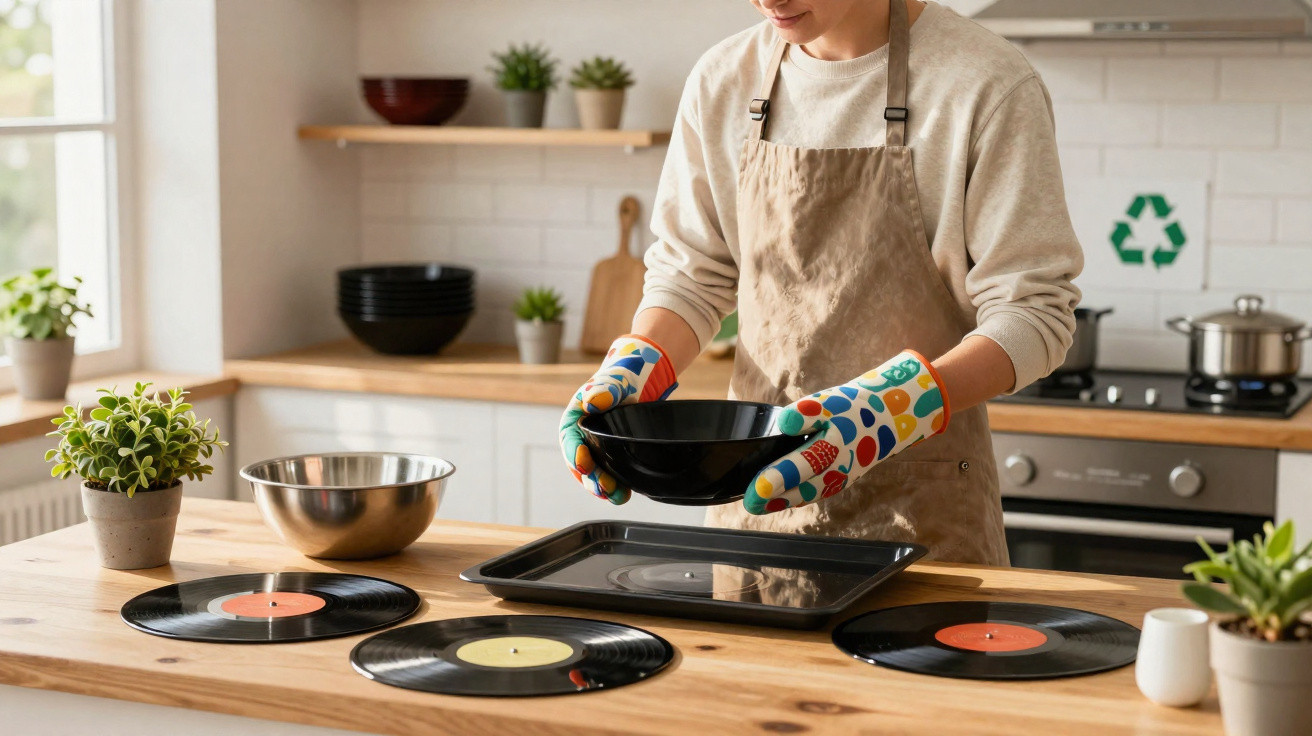
Many basements still hold boxes of scratched vinyl records, inherited collections or unlucky finds from a car boot sale. Nobody plays them any more, yet throwing them away still feels wrong. With a simple oven method, those discs can be turned surprisingly quickly into distinctive home accessories - no specialist tools required, and with a clear benefit for waste reduction.
Why damaged vinyl records are far too good for the bin
Vinyl records are the sort of item people dislike disposing of. They represent memories, music history and a particular way of life. At the same time, plenty of older records can no longer be played properly because they are heavily scratched or warped.
That is exactly where creative reuse comes in. Rather than letting old albums disappear unceremoniously into the general waste, they can take on a second role: as a bowl, a decorative object or an unusual gift. It frees up space at home, cuts down on rubbish and adds a pleasing retro touch to a room.
"The trick: vinyl is sensitive to heat - and that’s exactly what this household hack takes advantage of."
The simple science behind the oven method
Vinyl records are usually made from PVC, a so-called thermoplastic. At moderate temperatures, this material becomes soft and shapeable without immediately melting. Once it cools again, it keeps whatever form you have given it.
The key is getting the temperature right. The ideal range is roughly between 100 and 120 °C. Within that window, the record becomes flexible within a few minutes, without slumping uncontrollably or forming bubbles.
- below 100 °C: little to no effect - the record stays rigid
- around 110 °C: ideally soft and easy to shape within 3–5 minutes
- above 120 °C: higher risk of warping, unpleasant odours and damage
That brief moment of softness is all you need to turn a flat disc into a decorative object - essentially customised to your own taste.
A design bowl from an old vinyl record in five minutes
The best-known version of this method is a decorative bowl you can use later as a drop zone in the hallway, a container for odds and ends, or a focal point on a shelf. The process is surprisingly straightforward.
Step-by-step guide
- Preheat the oven to about 110 °C.
- Line a baking tray with baking paper so nothing sticks and no residue is left behind.
- Place a heatproof glass or ceramic bowl upside down in the centre of the tray to act as a mould.
- Set the vinyl record centrally on the upturned base of the bowl.
- Slide the tray into the oven and stay nearby.
- After around three minutes, the edges of the record will start to droop and conform to the shape beneath.
- Remove the tray using oven gloves.
- Immediately use heatproof hands (or a cloth) to gently press the still-soft record into folds or waves until you achieve the shape you want.
- Leave the shaped record to cool undisturbed for around ten minutes.
Afterwards, you will have a sturdy bowl that works well as a decorative tray. If you want a deeper body, press the centre down a bit more while it is warm - this creates a vintage-style shape similar to a fruit bowl.
From a broken album to a plant pot sleeve
Another popular option is to use a record as an outer sleeve for plant containers. In this case, you simply seal the central hole of the record:
- either with a small amount of two-part epoxy putty
- or with a suitably cut cork that fits snugly
You then place an inner pot made of plastic or ceramic inside, which holds the soil and water. This keeps the vinyl shape dry, while your windowsill gains a striking retro plant pot that is guaranteed to stand out.
"From records that are effectively worthless, you can create one-off pieces you won’t find off the shelf in any homewares shop."
Safety, health considerations and choosing the right records
If you plan to heat vinyl in the oven, you should follow a few rules carefully. PVC is not a material for high-temperature experimentation. The oven temperature must not exceed 120 °C. A kitchen thermometer placed in the oven cavity can help you keep it under control.
While the record is heating, open a window or switch on the extractor hood. This helps any potential fumes disperse quickly. During this stage, children and pets should be kept at a distance to prevent burns or curious hands (or paws) getting involved.
Once heated, records are not intended for direct contact with food. If you want to serve fruit, sweets or snacks in such a bowl, place a glass or ceramic bowl inside, or use packaged items. For loose nuts or fruit, an insert works just as well - as does a suitable napkin or a paper doily.
Which records you should avoid reshaping
Before you put your first disc in the oven, it is worth checking whether it has any collector value. Some pressings can fetch high prices even if they are not in perfect visual condition. Limited runs, special colours or well-known bands may be valuable.
A simple rule of thumb:
- Records with clearly visible deep scratches and cracks are well suited for craft projects.
- Anonymous collections of schlager or classical music without notable artists rarely have much market value.
- Signed albums, first pressings and special editions are better checked by someone knowledgeable.
If you are unsure, you can quickly search the album title online along with “vinyl value” to get a rough sense of what it might be worth.
More ideas for giving vinyl a second life
The oven bowl is only one approach. If you would rather not work with heat, old records can be repurposed in other ways. Wall clocks are particularly popular: fit a battery-powered quartz clock movement through the centre, add hands, and you have an individual wall clock. The centre label remains visible and is usually the main visual draw.
Wall pieces are just as quick to create. Several records can be arranged into geometric shapes, or fixed in a large frame alongside photos and concert tickets. The result is a music or memory board that can shape the feel of an entire room.
If you still have playable records but want to part with the format, you can often find appreciative takers at car boot sales, on online classifieds sites or in second-hand record shops. That way, well-kept records end up back on a turntable rather than in the bin.
Practical notes for everyday use and sustainability
This trick fits neatly with the idea of creative reuse: turning items you were going to discard into new objects. Vinyl is particularly suitable because it is robust, easy to wipe clean and visually distinctive. The black, glossy surface works with many interior styles - from industrial to boho.
If you work with old records more often, you can experiment with different moulds: smaller bowls, larger dishes with a wide rim, or even tiered cake stands made by connecting multiple vinyl records with metal rods. Each record responds slightly differently depending on its thickness and age, which is part of the appeal.
A question that comes up frequently is whether there will be any smell. At low temperatures and with short heating times, this is usually very limited. If you are sensitive, ensure good ventilation and work in stages rather than reshaping many records back to back.
Finally, it is worth considering space. The new bowl or plant pot does take up room, but it typically replaces other decorative items or trays you no longer need. That way, you are not adding more clutter - you are making a deliberate change, with a personal story behind each piece.
Comments
No comments yet. Be the first to comment!
Leave a Comment