
It nearly always begins with the best of plans. On a Saturday you wipe down the dining table, fold the throws on the sofa, and arrange the spice jars like little guards on parade. The place feels calmer, and so does your head, and you promise yourself you’ll keep it like this. Then, a week later, the post has wandered back, the laundry basket is bursting, and a baffling stack has appeared on the chair that was meant to stay clear “only this once”.
You scan the room and that familiar pinch of failure hits. Is it you-untidy, lazy, simply not “one of those organised people”? Or could the setup be quietly designed to trip you up?
There’s a single, surprisingly basic rule that often determines whether order sticks-or whether things drift back into chaos.
The simple rule that quietly changes everything
Here it is: every single object needs an easy, obvious home. Not an imaginary home. Not a Pinterest-perfect home. A home your half-asleep, doom-scrolling, stressed-out self can use on autopilot. When something doesn’t have a proper place, it becomes a drifter. It settles on the nearest surface, blends into a miscellaneous pile, and then attracts more strays.
Our brains are built for shortcuts. If “putting it away” takes more than a couple of simple moves, your brain will choose “I’ll deal with it later.” And “later” tends to become the junk drawer, the chair-pile, or the suitcase you never fully unpack. Organisation usually falls apart not because you lack willpower, but because the route from “in my hand” to “back where it lives” is just too long.
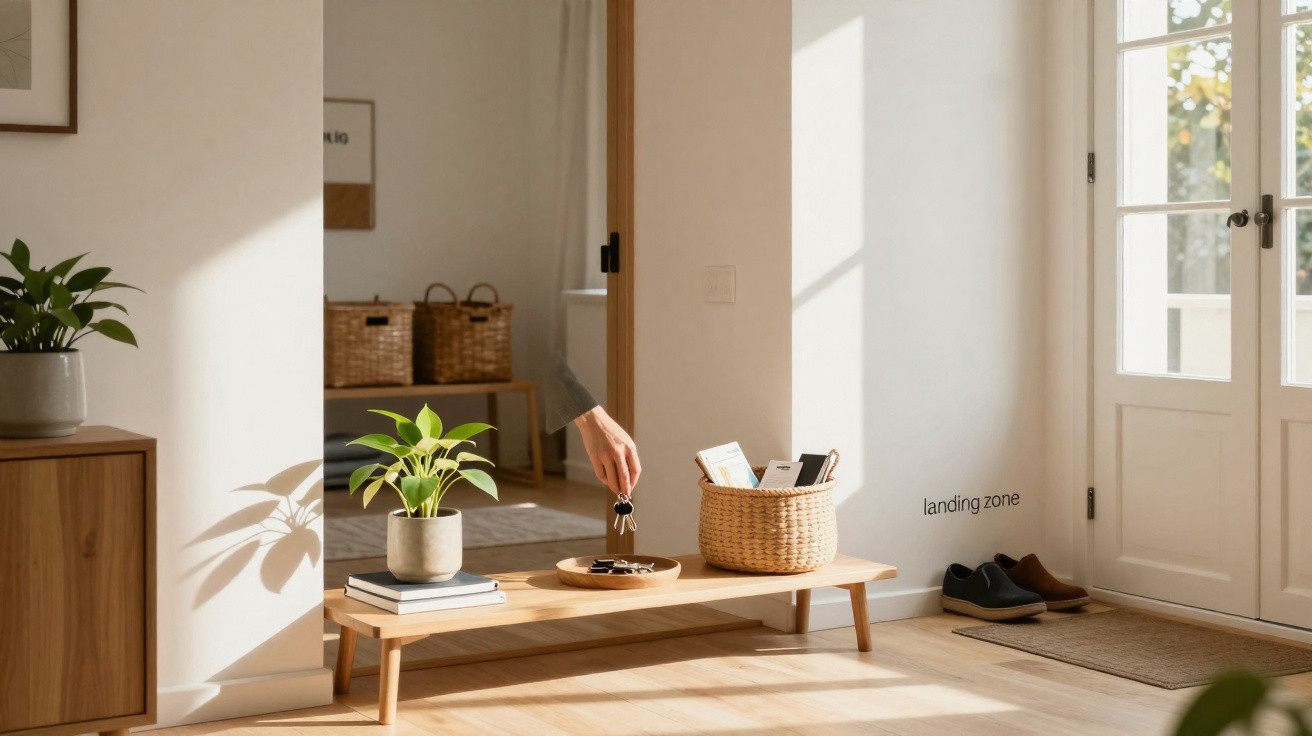
Consider your keys. People who rarely misplace them are almost always following this rule-often without noticing. There’s a bowl by the front door, a hook on the wall, a small tray on the console. Same place, every time. No hunting, no decision-making. That’s what an easy, obvious home looks like.
Now think about the items that endlessly migrate around your home: scissors, phone chargers, sticky tape, water bottles. One day they’re on the kitchen worktop, then on the coffee table, then in the bedroom, then in the car. Each time you need one, you’re on a mini treasure hunt. You sigh, maybe swear, and sometimes buy another “as a spare”. A lot of clutter is simply homeless objects multiplying.
When you assign a genuine home to each item, you’re doing more than sorting possessions-you’re reshaping behaviour. This works because it eliminates tiny, draining choices. Instead of “Where on earth does this go?”, it becomes “This goes here.” Once the rule is in place, your brain can unclench.
And yes-nobody manages this flawlessly every day. Life happens: children, late nights, early alarms. But when everything has a home, mess stays shallow. It gathers on the surface and can be reset quickly, like leaves swept straight into waiting bags. The system is forgiving because it’s designed for real life, not an idealised version.
How to give things a home your future self will actually use
Begin with a single hotspot rather than trying to conquer the entire house. Choose the area that irritates you most: the pile in the hallway, the bathroom counter, the desk that keeps “exploding”. Pay attention to what actually ends up there-rather than what you think ought to be there. That’s your honest starting point.
Next, pair each repeat-offender item with a home as close as possible to the spot where you naturally use it or drop it. Post? A basket by the door. Headphones? A small dish by the sofa. Dog lead? A hook at a height you’ll genuinely use, not at “looks nice in a photo” height. If you need to walk through rooms to put something away, that thing is unlikely to make it home.
A common trap is choosing systems that are attractive but impractical. A tall box with a lid looks neat in a picture, but the lid becomes friction-so the post ends up on top instead. A filing cabinet in the spare room may feel “properly organised”, yet it’s three steps and a door away. Your brain does silent arithmetic and decides it’s not worth it.
You’ve found the right home when returning the item is nearly as effortless as dropping it on the table. Think lidless baskets, open shelving, shallow drawers, and clear containers. The simpler the movement, the more it turns into habit. That’s how organisation starts to sustain itself-even during your worst weeks.
One more shift helps: stop trying to “declutter your life” and focus on removing one everyday annoyance at a time. The hairbrush that keeps vanishing. The reusable bags you forget every supermarket trip. The charger that gets borrowed from room to room. Give each one a home that matches how you actually live.
“Organizing isn’t about perfection. It’s about reducing friction between you and the life you’re actually living,” says a professional organizer I once interviewed, who admitted her own kitchen junk drawer is very real, just tamed.
- Put everyday essentials within easy reach, not buried at the back of a cupboard.
- Use open, visible storage for items you pick up daily.
- Keep things where you naturally use or drop them, not where they “ought” to live.
- Trial your setup for a week, then tweak it if you keep sidestepping it.
- Let containers act as limits: when they’re full, that category has reached capacity.
The quiet power of small, honest systems
Once you start applying this rule, a subtle change kicks in. You stop treating the mess as a personal failing and begin seeing the layout of your routines. Shoes by the door aren’t proof you’re hopeless-they’re evidence that the current shoe spot is too far away, too low, or too awkward. Make-up spread across the bathroom sink is your brain saying, “I need this within reach, not zipped into a pouch.”
You may notice your standards becoming both gentler and clearer. Gentler, because your home doesn’t need to resemble a magazine shoot. Clearer, because you begin to recognise clutter as a design issue rather than a character flaw. Add a hook here, a tray there, a small box by the bed, and suddenly your evening feels less snaggy.
At that point, the rule becomes less about belongings and more about self-respect. Giving everything a home is a way of saying: my time matters, my energy matters, and my mornings shouldn’t begin with a frantic key search. You’re building tiny supports for your future self-the one who’s running late, exhausted, or simply in a foul mood.
Some people get a burst of motivation and want to redo the whole house in a weekend. You can-but it’s not required. Working one surface at a time is enough. One drawer. One rucksack. Each new “home” removes one small daily irritation. That kind of change doesn’t announce itself on day one; it murmurs every morning when you find what you need in two seconds.
You may also find you buy fewer things. When every new item must have a place to live, shopping shifts into a different question: “Where will this go?” Not in a vague “I’ll find somewhere” sense, but in a specific, concrete one. No home, no purchase. That single filter can prevent a surprising amount of clutter from ever coming through the front door.
Perhaps that’s the quiet magic of this simple rule. It doesn’t promise a flawless home. It offers a kinder one: a space shaped around how you and the people you love really move, drop things, forget, rush, and rest. A home you can mess up on a Tuesday night and reset in ten minutes on Wednesday morning, with low light and the kettle on.
| Key point | Detail | Value for the reader |
|---|---|---|
| Every object needs an easy, obvious home | Place items where you naturally drop or use them, not where they “should” go | Reduces friction and helps organisation maintain itself over time |
| Keep storage simple and open | Use trays, baskets, hooks, and shallow drawers without lids or complex steps | Makes it almost effortless to put things away, even when tired or busy |
| Fix one irritation at a time | Start with hotspots and frequently lost items, then expand slowly | Creates sustainable change without overwhelm and builds quick wins |
FAQ:
- Question 1 What if my home is small and I feel like there’s no space to give everything a home?
Start by cutting down duplicates in high-clutter categories (mugs, bags, skincare, cables). Then choose compact, vertical options: hooks on doors, magnetic strips, wall shelves, over-the-door organisers. The aim isn’t more space-it’s clearer, more deliberate homes for fewer items.- Question 2 How do I get my partner or kids to respect these “homes”?
Make it extremely simple and easy to see: labels, pictures for children, open bins by the door. Describe the payoff in their terms (“You’ll always find your favourite toy” or “No more morning key panic”), and let them help pick locations so it feels shared rather than imposed.- Question 3 What if I keep ignoring the homes I set up?
Treat that as useful information, not a failure. It usually means the home is too far away, too hidden, or too fiddly. Move it to where the item truly lands, remove lids, or swap to a larger container. Your behaviour is the honest signal-adjust the system to match it.- Question 4 Do decorative items also need specific homes?
Yes-although their “home” is often simply a chosen, intentional spot: this shelf, that sideboard, this wall. When décor has a clear place, you spot when surfaces begin collecting random extras and you can reset more quickly.- Question 5 How long does it take before this feels natural?
Most people notice a change within a week in one targeted area, such as the hallway or the desk. After repeating “this goes here” dozens of times, it becomes muscle memory. Over a month or two, the rule stops feeling like a rule and starts feeling like how your home naturally works.

Comments
No comments yet. Be the first to comment!
Leave a Comment