
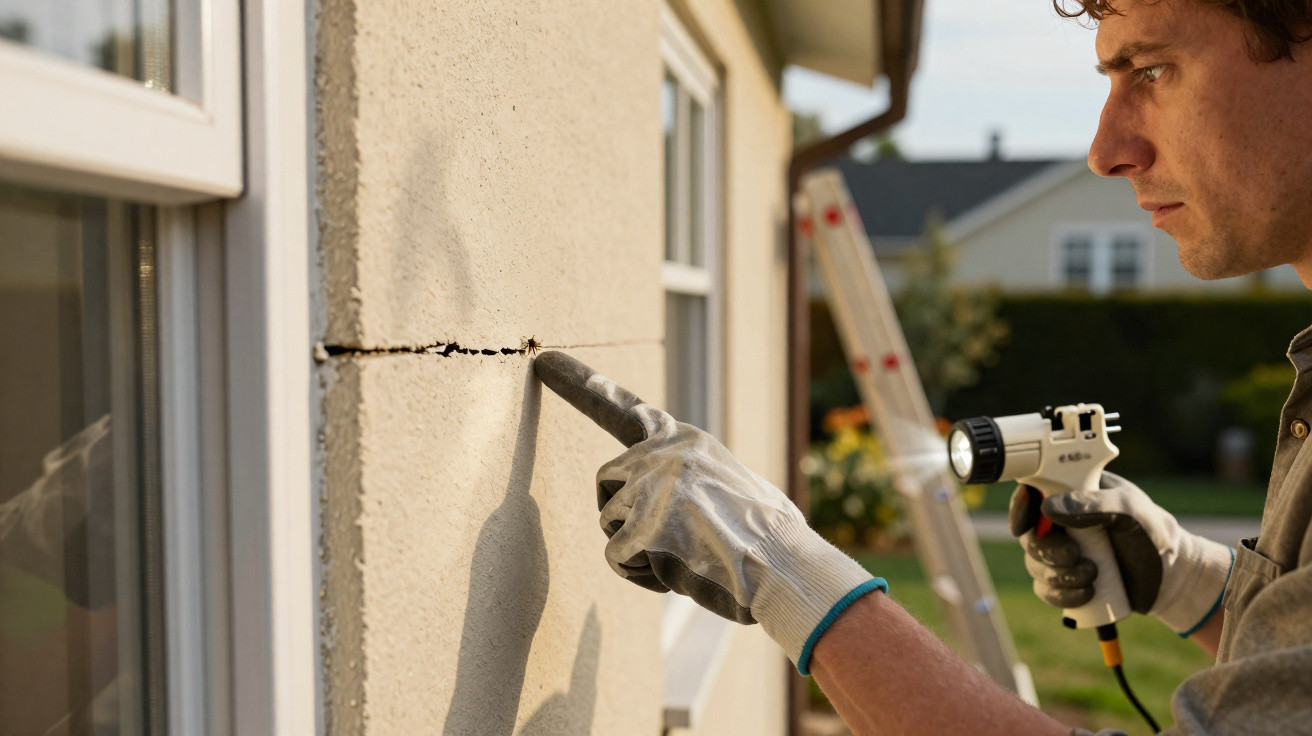
A hairline crack in the render, barely visible to the naked eye, can be enough in spring for a hornet queen to choose your home as the ideal nesting site.
Each spring, many homeowners notice a large, dark insect repeatedly circling the same patch of wall. There is no obvious hole and no visible nest - just a minor flaw in the render or an ageing strip of sealant. Yet that can be all it takes for the first stage of a hornet nest to begin, and by summer it may house thousands of insects.
Why a 5 millimetre gap is so appealing to hornets
After winter - roughly from mid-February to the end of May - surviving hornet queens leave their overwintering shelters. Every queen then searches for somewhere secure, dry and sheltered from wind to establish a new colony. While many people assume they head for trees or lofts, house façades are also highly attractive, particularly where insulation is poor.
The key factor is the so-called thermal bridge effect. In weakly insulated areas, a small amount of indoor heat continuously leaks out. Most people would never notice it, but to a hornet it is a clear signal: the space behind this spot is warm, dry and stable.
"A single crack of around 5 millimetres in a warm façade can act as a ‘beacon’ for a hornet queen - and lay the foundations for a full nest."
A tiny gap in render, a loosened seal around a roller shutter box, or a slit beneath a roof tile can be enough. Behind such openings, temperatures are usually fairly consistent - exactly what the queen needs to build what is known as a primary nest: a small, paper-like sphere about the size of a table tennis ball. Over the course of summer, this can develop into a larger secondary nest with up to 2,000 individuals.
Typical weak points: where the risky 5 millimetre gap hides
Problem areas on homes tend to crop up again and again. Tradespeople and pest-control professionals repeatedly point to the following spots:
- Roller shutter boxes and their joints to the masonry
- Window frames and window sills
- Eaves and cornices
- Junctions between the house wall and a canopy or conservatory
- Undersides of balconies and patio slabs
- Gaps under verge tiles on the roof
One commonly reported scenario goes like this: in April, a hornet queen squeezes through a perished seal on a roller shutter box, builds her first nest inside and enlarges it week by week. By summer, the shutter may start creaking or sticking because the nest is in the way. At the latest, if someone yanks hard on the strap in August, the insects feel threatened - and may respond aggressively.
In areas that are heavily affected, thousands of nests are removed professionally every year. At the same time, A&E departments and GP practices see more stings from stinging Hymenoptera such as wasps and hornets. When the nest is close to the house, the chance of triggering defensive flights rises - whether you are airing rooms, having a barbecue on the patio, or gardening.
Warning signs on the façade: how to spot the risk early
If you pay attention in spring, you can often stop a nest from becoming established. A focused check of the exterior only takes a few minutes, but it can prevent a great deal of trouble.
What to look for on a walk-round
On a mild day, walk slowly around your home and focus on roller shutter boxes, roof edges and window corners. The following signs are particularly suspicious:
- The same large, dark insect repeatedly approaches one specific spot on the building.
- Small grey crumbs or paper-like fragments are lying on the ground directly below the wall.
- Under an overhang or in a recess there is a small grey ball with a honeycomb-like structure - like papier-mâché.
At this stage, the colony is still very small, and the situation can usually be clarified without much risk. If there is already a larger nest or heavy flight activity, keep your distance.
"An early spring check prevents an unremarkable gap from turning into a stinging problem with thousands of insects."
How to secure suspicious gaps and keep hornet queens away
If you can identify a gap and it is not yet occupied, you can take action yourself. The aim is to seal the opening and make the area unattractive for nesting attempts.
Seal gaps and protect ventilation openings
- Close open cracks in render: Carefully fill them with weatherproof exterior mortar or façade filler.
- Check joints around windows and roller shutter boxes: Replace brittle silicone or acrylic seals and swap out loose sealing strips.
- Secure ventilation openings: Fit fine mesh grilles so insects cannot crawl inside.
- Inspect the roof edge and junctions: Reposition loose verge tiles and close visible gaps with a suitable material.
If you already have a painter or roofer working on the property, it is worth asking them to look specifically for these thermal bridges. Professionals often spot issues immediately and can recommend an appropriate fix on the spot.
Use natural scents as a deterrent
For extra deterrence, some homeowners rely on strongly scented oils. A simple mix that has proved practical is:
- Put 500 millilitres of water into a spray bottle
- Add about 10 drops of clove oil or peppermint oil
- Shake well and spray onto suspicious areas every 14 days
The intense smell is intended to confuse searching queens and encourage them to choose a different place to nest. This approach does not replace proper sealing work, but it can be a useful supplement.
When it is better to call a professional
As soon as there is an active nest, caution is essential. Anyone who tries to remove or destroy a nest themselves risks receiving a large number of stings at once. It becomes particularly tricky when the nest is:
- inside a roller shutter box
- hidden beneath roof tiles
- located in hard-to-reach voids
In these situations, close nearby windows and doors, bring children and pets indoors, and contact a pest controller. Depending on how accessible the nest is, costs are usually in the low to mid three-figure range.
"People who try to deal with a hornet nest themselves often underestimate the speed and aggression with which dozens of insects can attack at the same time."
How dangerous are hornets really - and who needs to be especially careful?
Hornets are generally considered relatively peaceful as long as you stay calm and do not shake or disturb the nest. Even so, multiple stings in a small area, or a sting affecting someone with an allergy, can have serious consequences. Stings in the mouth or throat are also critical - for example, if an insect is accidentally swallowed with a drink.
The following groups should be particularly cautious:
- People with a known insect-venom allergy
- Small children who cannot yet judge when to keep their distance
- Older people or those with pre-existing heart and circulatory conditions
During summer, allergy sufferers should keep an emergency kit close to hand (for example, with an adrenaline auto-injector, an antihistamine and cortisone). After multiple stings or severe swelling, the rule is: do not wait - seek medical help.
Why façade prevention is doubly worthwhile
Looking after your façade does more than deter unwanted guests: it also improves your home’s energy efficiency. Thermal bridges push heating bills up while simultaneously giving insects a kind of signpost towards sheltered cavities. Regularly dealing with seals, joints and damaged render therefore pays off financially - and saves stress.
A small spring checklist can help you stay on top of it: walk the façade, inspect corners and edges, photograph suspicious spots and repair them where necessary. Repeating this each year greatly reduces the risk of hornet nests - and, as a bonus, gives you a much clearer sense of your home’s condition.






Comments
No comments yet. Be the first to comment!
Leave a Comment