
You slide open the kitchen drawer for the third time and still can’t spot the scissors you’re certain belong in there. The tape measure? Apparently lurking somewhere behind the soy sauce. Your earbuds? Technically “on the shelf”… just hidden beneath a winter scarf you haven’t worn in two years.
You’re not necessarily untidy. It’s just that your things have a talent for vanishing precisely when you need them.
That’s the quiet cost of day-to-day life: minutes lost to searching, small spikes of stress, and the nagging feeling you must own three of everything because you can’t locate the first two.
There is an escape route-and it doesn’t require making your home look like a showroom.
It begins with one question: how visible are the things you use the most?
The simple visibility rule your future self will thank you for
Take a look around the room you’re in and identify what you touch every day: your keys, phone charger, favourite mug, notebook. Chances are they aren’t sealed away in a box under the bed. They’re out in the open somewhere-perhaps not neatly, perhaps not perfectly, but accessible.
That’s the clue: everyday items prefer to be visible. They belong close to where life happens-by the front door, beside the sofa, near the bed-rather than trapped in a “perfect” storage setup that looks impressive but rarely gets used.
Think of a hallway you know where everyone leaves keys “for a second”. Maybe it’s a dish on a console table, a hook that appeared one day, or a basket that slowly became the household dumping ground. Over time, that place turns into untouchable territory. You stop deciding; your hand just goes there.
It isn’t necessarily attractive. It could be a chipped bowl and a tired old nail. But it outperforms the most Pinterest-ready pegboard when no one actually sticks to it. This is organising as it happens in real life.
There’s also a reason these “obvious” spots feel easier: your brain leans on visual cues to run habits. When what you need sits in your line of sight, your mind uses less energy searching and more energy getting on with the task. Put daily essentials in opaque boxes, deep drawers, or behind solid doors, and the mental effort climbs.
And realistically, no one does the ideal routine every single day. On a busy Tuesday evening, you’re not going to carefully file headphones, passes, and remotes into labelled containers. The most effective system is the one that demands almost no thought or willpower-one that supports the mess of real life instead of battling it.
“The best organizing system is the one you can keep going on your worst day, not your best,” says a professional organizer I interviewed who spends half her time undoing over-complicated systems from social media.
The best way to store what you use most: visible, reachable, and boringly obvious
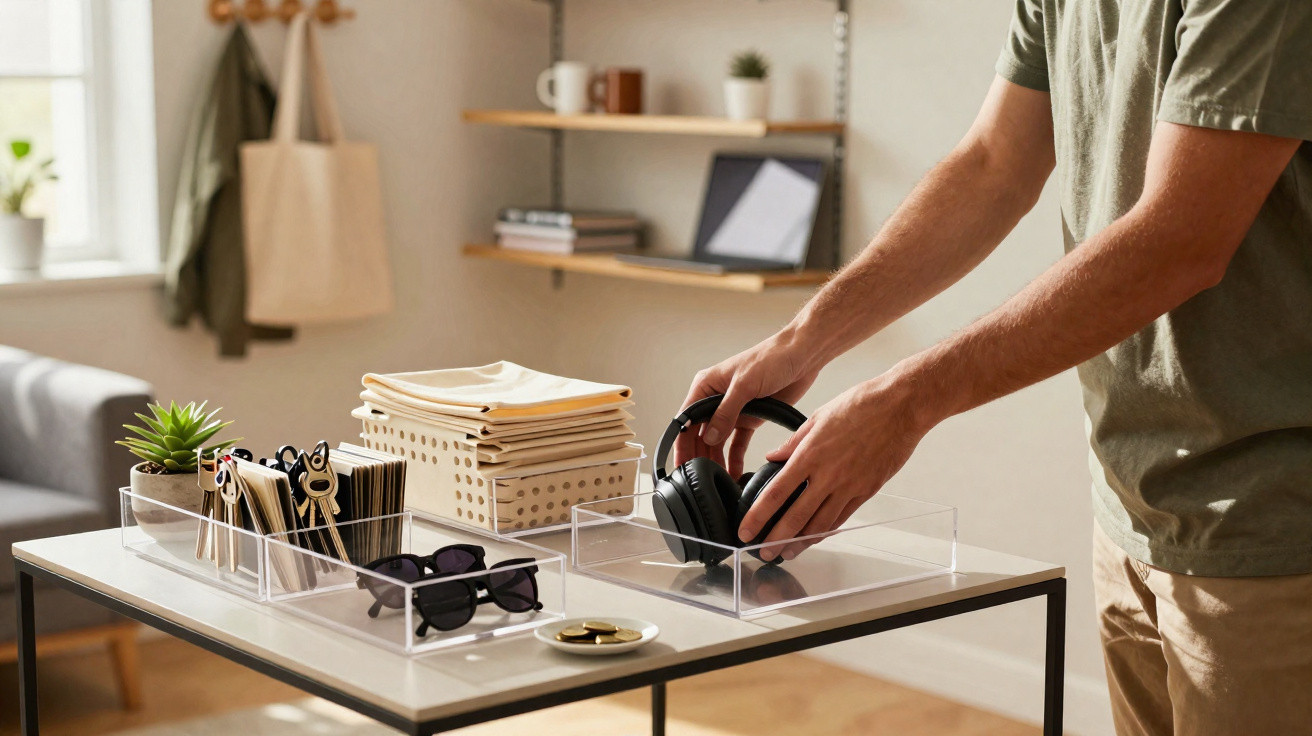
A practical rule of thumb: if you touch something daily, it deserves a visible “front row” home at eye level or within easy reach. In general, open beats closed, shallow beats deep, and clear beats opaque.
That could look like hooks or a wall rail by the door for keys and a tote bag. Or a slim, open tray on your desk for pens, lip balm, and that one USB stick you always need. Or a clear box on the bottom fridge shelf where the yoghurt, cheese strings, or chopped veg reliably sit. It can feel almost too basic-and that’s the point. You shouldn’t have to remember where things belong; you should be able to see it immediately.
A common mistake is trying to hide absolutely everything: cupboard doors, lids, decorative baskets with no labels. It feels calm for a day, then slowly turns into a guessing game-which basket has the chargers now? You pull everything down, rummage through it, and suddenly your “minimal” shelf looks worse than before.
Be considerate of the tired version of you who gets in at 8 p.m., arms full, brain frazzled. That person isn’t going to open three containers just to put sunglasses away. They’ll drop them on the nearest flat surface. When storage clashes with your instincts, your instincts win every time.
- Keep daily items at eye or hand level – Shelves between shoulder and hip height are the best real estate. That’s the zone for keys, notebooks, skincare, and remote controls.
- Use open, shallow containers – Trays, low-sided bins, and rails keep everything visible so nothing disappears into the back of a dark corner.
- Give each item a single obvious home – One hook for keys, one tray for chargers, one basket for post. No “sometimes here, sometimes there”.
- Choose clarity over aesthetics – Clear boxes, open shelving, and straightforward hooks beat pretty lidded storage you forget exists.
- Store for how you actually live, not how you wish you lived – If shoes naturally gather by the door, you don’t need more discipline; you need a visible shoe spot right there.
Living with visible storage without feeling like you live in a warehouse
The aim is a balance: visible, but still calm. You don’t need every possession on display-only the items that genuinely earn a daily place in your routine. Everything else can stay “backstage”.
Walk through your home and ask in each room: “What do my hands reach for here, every single day?” Those are the things that deserve an easy, open, obvious spot. The rest can be stored with a little more effort. It’s a quiet way of aligning your space with what actually matters to you.
When your essentials stop playing hide-and-seek, you may notice the room feels lighter-and you feel lighter in it, too.
| Key point | Detail | Value for the reader |
|---|---|---|
| Front-row storage | Keep daily-use items at eye or hand level using open or shallow containers | Cuts down search time and reduces everyday stress |
| One obvious home | Give each frequently used object one clear, visible place | Helps habits run on autopilot and makes the system easier to keep up |
| Store for real life | Build storage around where things naturally end up and how you actually move through the space | Creates a realistic setup that lasts beyond the first tidy weekend |
FAQ:
- Question 1 Should everything I use often be out on display?
- Answer 1 No. Only items you use daily or nearly daily need visible homes. Things you use weekly or monthly can live a bit further away or behind doors, as long as they’re still quick to grab.
- Question 2 What if visible storage makes my space feel cluttered?
- Answer 2 Keep each “station” limited to a small number of chosen items and use matching trays, hooks, or bins. Visual grouping creates a sense of order even when items are left out.
- Question 3 How do I stop family members from dropping things everywhere?
- Answer 3 Give them specific, extremely obvious landing spots exactly where the dropping happens: a basket by the sofa for remotes, a tray by the door for keys, and one hook per bag with names or colours.
- Question 4 Is labelling necessary if everything is already visible?
- Answer 4 Short labels still help when multiple items share a shelf or bin. They’re particularly handy for children, guests, or shared areas where “What goes where?” becomes a daily issue.
- Question 5 What’s one quick change I can make today?
- Answer 5 Pick one hotspot-such as the entryway or coffee table-and set up a simple open station: a tray for small items and a hook or basket for the rest. Use it for a week, then tweak it based on what actually ends up there.

Comments
No comments yet. Be the first to comment!
Leave a Comment